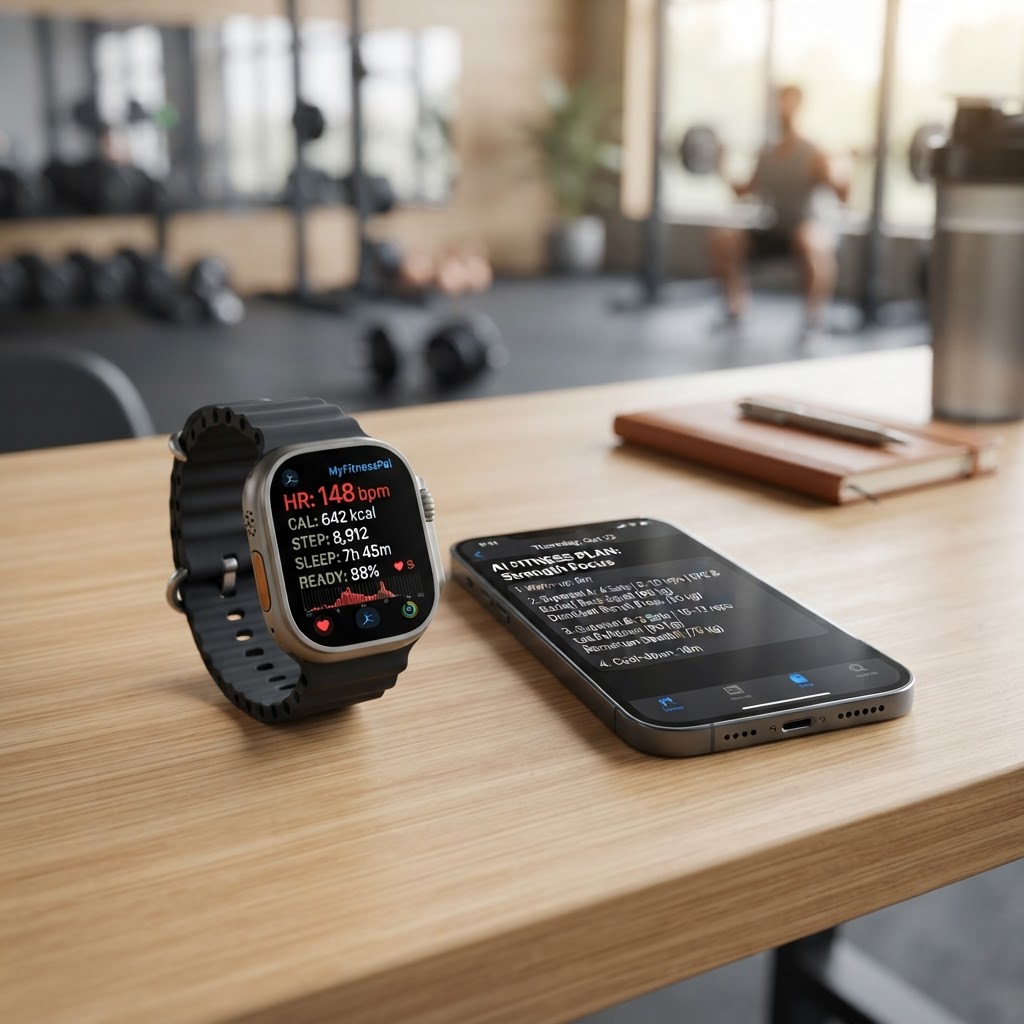
- AI fitness apps now offer hyper-personalized coaching by analyzing thousands of data points regarding user performance and recovery.
- Choosing between MyFitnessPal, Freeletics, and Fitbod depends on whether your priority is metabolic tracking, bodyweight conditioning, or strength training.
- Modern AI-driven platforms act as 24/7 accountability partners, adjusting workloads in real-time based on sleep, stress, and previous session intensity.
- Integration with wearable technology is the standard for the best health AI tools 2026, allowing apps to automate physiological data ingestion.
- Successful transformation requires a balance between algorithmic precision and human consistency in following recommended nutrition and activity plans.
The landscape of personal health is undergoing a seismic shift as we enter 2026. For decades, achieving peak physical conditioning was a luxury reserved for those who could afford private coaches, high-end nutritionists, and constant physiological monitoring. Today, the democratization of fitness is being driven by sophisticated algorithms. Whether you are seeking a structured weight loss path or a path toward hypertrophy, the best AI fitness apps act as a bridge between raw data and actionable human behavior. In this deep dive, the aismarttoolsreview editorial team evaluates the titans of the industry—MyFitnessPal, Freeletics, and Fitbod—to determine which platform best integrates into your life to optimize your metabolic health and strength.
1. How AI is Revolutionizing Personalized Fitness Coaching
The traditional model of fitness coaching relied heavily on static plans. A trainer would typically write a program that lasted for four to six weeks, assuming that the individual’s physical state, recovery capacity, and schedule would remain linear throughout that timeframe. We know, however, that biology is rarely linear. AI is revolutionizing this by introducing dynamic adaptability, which is the cornerstone of the best health AI tools 2026.
At the architectural level, AI in fitness operates by ingestion and pattern recognition. When a user logs a workout or a meal, the AI does not simply store that data; it compares it against the user’s established baseline and global data sets from millions of other users. For example, if an AI detects that a user consistently reports lower energy levels or diminished lifting performance on Mondays, it can dynamically adjust the intensity or volume for that specific day. This is a level of hyper-personalization that even human trainers often struggle to maintain without constant, exhaustive communication. The AI acts as a sophisticated feedback loop. As you provide input—whether through wearable device telemetry or manual logging—the system updates your personalized workout plans. It effectively calculates the “progressive overload” curve in real-time, preventing the common plateau effect that occurs when a workout becomes too easy or the risk of burnout when it becomes too intense. Furthermore, the evolution of Large Language Models (LLMs) integrated into these apps now allows for natural language interaction. Instead of just viewing a spreadsheet, you can ask your app, “Why did you lower my volume today?” and receive an explanation based on your recent cardiovascular health metrics or sleep data.
2. Why Use AI Instead of a Human Personal Trainer?
While human trainers provide emotional support and physical form correction, AI-driven platforms offer advantages in consistency, affordability, and data synthesis. For most individuals, the primary barrier to fitness is not a lack of knowledge, but a lack of consistent, data-backed execution. An AI nutrition coach or fitness bot never has an “off day.” It does not bring personal biases into your programming, and it does not forget the minor details of your performance from three weeks ago.
From a cost-efficiency perspective, the best AI fitness apps provide 24/7 access to coaching logic for a fraction of the cost of a monthly human trainer. The scale at which AI processes information is its greatest strength. A human trainer can observe your form in real-time, which is undeniably valuable, but the AI can process your calorie expenditure, heart rate variability (HRV), sleep duration, and macro-nutrient intake simultaneously. It then synthesizes these disparate data points into a single decision—such as recommending a deload week or a specific macro adjustment. This is particularly useful for users who have erratic schedules. If you miss a scheduled session, a human trainer might be forced to cancel or reschedule; the AI simply recalibrates the entire week’s schedule to ensure you still hit your micro-cycle goals. This adaptability makes AI an ideal companion for the modern, busy professional. It minimizes the decision-making fatigue associated with fitness, essentially automating the planning process so that the user only needs to focus on the execution of the task at hand. By removing the guesswork, these platforms ensure that every minute spent in the gym or preparing a meal is optimized for the user’s specific goals.
| App | Primary Focus | Best For |
|---|---|---|
| MyFitnessPal | Nutrition & Metabolic Tracking | Calorie counting and macro management |
| Freeletics | Bodyweight & HIIT Conditioning | High-intensity, equipment-free athleticism |
| Fitbod | Strength Training & Hypertrophy | Data-driven weight lifting and muscle growth |
3. Key Features to Look for in AI Fitness and Nutrition Apps
Not all “AI” labels are created equal. When evaluating the best health AI tools 2026, it is essential to look beneath the surface marketing. A truly robust application should exhibit specific technical capabilities that enhance the user experience rather than cluttering it. First and foremost is interoperability. The app must be able to ingest data from third-party sources such as Apple Health, Google Fit, or dedicated wearable manufacturers. Without seamless data flow, the AI is essentially flying blind, relying only on what you manually enter—which is prone to user error and omission.
Second, look for the presence of “predictive modeling.” An advanced app should not just record what you did; it should predict what you should do next based on trends. If an app suggests a weight increase for a specific lift, there should be a logic behind it, such as “You have completed 90% of your sets at RPE 8 for the last three sessions.” Third, consider the user interface for meal planning. An AI meal planner should move beyond simple calorie arithmetic; it should account for dietary restrictions, local availability of ingredients, and even time-saving meal prep strategies. Many of the most effective tools now use computer vision—allowing you to photograph a meal to estimate nutritional content—which significantly lowers the friction of tracking. Finally, evaluate the “feedback loop velocity.” How quickly does the app adjust its recommendations based on your input? A high-quality AI system should display nearly instantaneous responsiveness. If you log a workout that was significantly harder than intended, your next scheduled workout should reflect an appropriate reduction in volume within minutes. This dynamic adjustment is what separates a static digital library of exercises from a true AI coaching partner. You are essentially looking for an ecosystem that prioritizes the user’s long-term sustainability over short-term intensity, ensuring that the programming remains consistent with the user’s physiological capacity throughout the training cycle.
4. MyFitnessPal: Advanced AI Tracking for Nutrition and Macros
MyFitnessPal remains the industry standard for nutritional documentation, primarily due to its massive, crowdsourced database which has been significantly bolstered by modern AI capabilities. In 2026, the application has evolved far beyond its origins as a basic calorie calculator. It now functions as a comprehensive AI nutrition coach that utilizes predictive analytics to help users reach their body composition goals with greater precision.
One of the standout AI features is the “Meal Scan” technology. By utilizing computer vision, the app can identify ingredients in a photo and estimate caloric density and macro-nutrient breakdowns, which significantly reduces the cognitive burden of logging. Furthermore, the integration of generative AI allows the app to offer personalized nutritional advice. If a user sets a goal for weight loss, the app does not just provide a caloric target; it analyzes historical logging patterns to identify “pain points”—times of the day or specific days of the week where the user is likely to exceed their caloric budget. It then provides proactive, non-judgmental suggestions, such as recommending higher-fiber foods for late-night snacking or adjusting macro ratios to improve satiety. As an AI weight loss tracker, it excels in its ability to reconcile the difference between what you plan to eat and what you actually consume. The algorithm continuously monitors the gap between your caloric budget and your reported intake, dynamically adjusting the remainder of your day’s plan to keep you within your metabolic sweet spot. For those who prioritize diet as the primary driver of their fitness outcomes, the depth of nutritional insights provided by MyFitnessPal is unmatched. It essentially functions as a data-mining operation for your own metabolic behavior, turning disparate food logs into a roadmap for weight management.
5. Freeletics: AI-Driven Bodyweight Workouts and HIIT
For users who prefer high-intensity, time-efficient, and equipment-minimal workouts, Freeletics has established itself as the leading AI-driven conditioning platform. The “Freeletics Coach” is an AI engine designed to simulate the decision-making process of a high-end athletic coach. It focuses heavily on bodyweight movements and HIIT (High-Intensity Interval Training), which makes it highly accessible for individuals traveling frequently or those who prefer working out in home environments without heavy machinery.
The core philosophy of the Freeletics AI is “adaptive conditioning.” When you begin a session, you are not just executing a static video. You provide feedback to the app after every exercise: How difficult was it? Did you struggle with the form? Was your cardiovascular system the limiting factor, or was it localized muscle fatigue? The AI processes this feedback in real-time to curate the next segment of your training. If you indicate that you were unable to complete the required repetitions of a burpee set with proper form, the AI will immediately identify that movement as a weakness and adjust the volume or intensity in the next training block. It builds a profile of your specific athletic capabilities, effectively creating a personalized workout plan that evolves as you do. This ensures that the user is always training at the optimal threshold of their potential—challenging enough to stimulate adaptation, but balanced enough to prevent injury. The app also features a “Hell Week” concept, which is essentially an AI-orchestrated peak training block. By analyzing the data from your previous weeks of performance, the app pushes you through a period of increased intensity designed to test your limits. This makes Freeletics an exceptionally powerful tool for those seeking to improve their relative strength, cardiovascular endurance, and athletic coordination. By stripping away the need for heavy equipment and focusing on functional, high-output movements, the AI-guided Freeletics approach removes the external barriers to starting a workout, making consistent fitness a byproduct of the app’s automated, highly personalized encouragement.
Fitbod: Leveraging Machine Learning for Intelligent Strength Training
Fitbod has carved out a unique position in the digital fitness landscape by focusing almost exclusively on the nuances of resistance training. Unlike apps that offer generic video classes, Fitbod employs a sophisticated machine learning engine designed to act as a digital strength coach. The core philosophy of Fitbod is “progressive overload,” the foundational principle of hypertrophy and strength gains, which is managed through a complex algorithm that tracks your history of sets, reps, and weight lifted across every muscle group.
The system works by maintaining a “recovery percentage” for each muscle group. When a user completes a workout, the app’s backend algorithm recalculates the fatigue level of the involved muscle fibers. This data is then used to suggest a workout plan for the next session that emphasizes fresh muscle groups while allowing others to recover. For powerlifters and bodybuilding enthusiasts, this is a game-changer because it eliminates the guesswork of programming splits.
Furthermore, Fitbod’s intelligence extends to its “Auto-Regulatory” capabilities. If a user encounters an unexpected hurdle—such as limited gym equipment or a sudden change in schedule—the app allows for real-time adjustments. When you inform the app that a piece of equipment is occupied, the AI instantly recalculates your session, finding a suitable alternative exercise that targets the same muscle group without sacrificing the integrity of the total training volume. This level of granular control is what sets it apart as a premier tool for users who prioritize efficiency in the weight room.
Comparing AI Workout Generation and Progression Algorithms
While Fitbod excels in strength, the broader landscape of AI fitness relies on different algorithmic frameworks. Some apps prioritize high-intensity interval training (HIIT) and calisthenics (like Freeletics), while others prioritize dietary compliance and macro-tracking (like MyFitnessPal). The primary difference lies in the “adaptation loop.”
| Feature | Fitbod | Freeletics | MyFitnessPal | Best For |
|---|---|---|---|---|
| Workout Engine | Strength/Volume-based | Calisthenics/HIIT-based | N/A (Integration-focused) | Fitbod: Strength |
| Progression | Weight/Rep adjustment | Skill-level scaling | Calorie/Macro target | Freeletics: HIIT |
| Recovery Tracking | Muscle-specific | Session intensity-based | None | MyFitnessPal: Nutrition |
Freeletics utilizes a “Coach” algorithm that is deeply rooted in biomechanical feedback. After each workout, users provide subjective feedback: “Was that too hard?” or “Did you struggle with form?” The AI uses this qualitative data to adjust the next week’s training block. If a user consistently struggles with burpees or pull-ups, the algorithm will decrease the volume of those specific movements while increasing the focus on foundation-building exercises, effectively acting as an iterative learning loop.
In contrast, MyFitnessPal’s “AI” approach is centered on data logging and trend analysis. It does not generate workouts but instead uses machine learning to predict your caloric intake needs based on the energy expenditure data pulled from your wearable devices. By cross-referencing your workouts (whether from Fitbod or another source) with your dietary logs, it provides a holistic picture of your caloric balance, effectively acting as an AI nutrition coach that prompts you to adjust your consumption based on your actual, rather than theoretical, activity level.
The Role of Wearable Integration in AI Fitness Success
The efficacy of modern AI fitness apps is inextricably linked to the quality of data they receive. Wearables—ranging from basic pedometers to advanced heart-rate monitors and continuous glucose monitors—act as the “sensors” for your health ecosystem. Without this integration, an AI tool is essentially flying blind, forced to rely on population averages rather than your unique physiological response.
When you sync a smartwatch or a heart-rate monitor to an app like Fitbod or Freeletics, you provide the system with “ground truth” data regarding your heart rate variability (HRV), resting heart rate, and active calorie burn. AI algorithms use HRV, in particular, as a proxy for central nervous system (CNS) fatigue. If your wearable detects a significant drop in your HRV, an intelligent AI coach should theoretically signal you to reduce the intensity of your scheduled workout. This is where the synthesis of technology truly shines: moving from static, pre-programmed plans to dynamic, response-based coaching.
For those focused on nutrition, wearables provide the missing link in the weight loss equation. Most people drastically overestimate how many calories they burn during exercise. AI-powered nutrition apps use integration to correct this discrepancy, subtracting or adding calorie allowances to your daily budget in real-time. This prevents the common trap of “eating back” exercise calories, which is the most frequent cause of plateauing in weight loss journeys.
How to Choose the Right AI Fitness Tool for Your Fitness Goals
Selecting the right AI fitness tool depends heavily on your specific objectives. If your goal is hypertrophy and pure strength, Fitbod is the clear leader due to its emphasis on weight progression and muscle recovery. If you are training for athleticism, body control, and cardiovascular endurance, Freeletics is better suited, as it emphasizes functional movement patterns over raw lifting volume.
If your primary challenge is dietary discipline, MyFitnessPal remains the gold standard, particularly when combined with an AI-integrated meal planner. However, the best approach is often “stacking” tools. Using Fitbod to manage your training schedule and MyFitnessPal to manage your nutritional intake creates a comprehensive system that tracks both inputs and outputs.
When making your choice, consider the “friction” of the tool. If the app requires too much manual logging, you are less likely to use it long-term. Look for tools that offer high levels of automation—auto-syncing from your wearable device is a must-have. Additionally, consider the “coach” persona. Some apps are task-oriented (do this, then do that), while others offer educational content and motivational cues. Choose the interface that aligns with your preferred style of instruction.
Common Mistakes to Avoid When Using AI for Health and Nutrition
One of the most dangerous mistakes users make is treating AI output as infallible. AI is a predictive tool, not a medical professional. Relying solely on an app’s recommendation to “push through” a workout when you are experiencing sharp pain is a recipe for injury. Always listen to your body first; if an exercise feels mechanically wrong or causes pain, skip it regardless of what the algorithm suggests.
Another common error is over-reliance on the “calorie math.” While algorithms are excellent at crunching numbers, human biology is dynamic. Hormonal cycles, sleep quality, and stress levels all impact your metabolism in ways that most apps cannot track. Use AI data as a guideline, not a rigid rule set. If the app suggests you eat 1,800 calories, but you are experiencing extreme fatigue, it is often wise to adjust your intake based on how you feel rather than forcing yourself to hit an arbitrary number generated by code.
Finally, avoid the “analysis paralysis” of tracking too many metrics. Some users become obsessed with every single data point—VO2 max, resting heart rate, daily macros, sleep stages—to the point where the tracking itself becomes a source of stress. Excessive stress elevates cortisol, which can actually hinder your fitness results. Keep your tracking meaningful by focusing on two or three key performance indicators (KPIs) that directly relate to your goals, and ignore the noise of peripheral metrics.
Frequently Asked Questions
Can AI fitness apps replace a human personal trainer?
While AI apps have become remarkably sophisticated at managing training volume and progression, they lack the human touch of a qualified coach. A human trainer can observe your form in real-time, adjust your technique to prevent injury, and provide the psychological motivation that an app cannot. For beginners or those with specific injuries, a hybrid approach—using an app for the baseline programming while consulting a human professional for technique—is often the most effective route.
Do I need expensive gym equipment to use AI fitness apps effectively?
Not necessarily. Most AI fitness apps, particularly those like Freeletics or certain modes within Fitbod, are designed to accommodate the equipment you have available. You can input your inventory—such as resistance bands, dumbbells, or even just body weight—and the AI will generate a workout plan tailored to those constraints. The effectiveness of the workout is determined more by consistency and intensity than by the cost of the hardware you are using.
How does AI ensure my nutrition plan is personalized?
AI nutrition tools analyze your demographic data, activity levels (via wearable sync), and your weight loss goals to establish a baseline. They then use machine learning to adjust these targets over time based on your progress. If your weight loss stalls, the algorithm may suggest a macro-nutrient shift or a caloric adjustment. However, for true personalization, these tools require consistent data entry; the more accurate your logging, the more precise the AI becomes at predicting your body’s needs.
Are AI-generated meal planners safe for individuals with dietary restrictions?
Most AI meal planners have robust filtering settings that allow users to select for allergies, intolerances, and preferences like vegan or keto diets. However, these tools are not clinical nutritionists. If you have severe allergies or complex medical conditions like diabetes, you should always treat AI suggestions as a starting point and verify them against professional dietary advice or your own medical knowledge to ensure safety.
How often should I change my AI workout plan?
The beauty of AI-driven apps is that they often adjust your program continuously. Instead of a rigid “four-week program,” modern AI apps usually adjust the intensity after every single session. You do not need to manually change your program; the software handles the periodization for you. If you find yourself hitting a plateau for more than three weeks, it is usually a sign that you should adjust your overall goal settings or increase the intensity parameters within the app.
Is the data privacy of these apps a concern?
Health data is highly sensitive, and users should be vigilant. When using these apps, review the privacy policy specifically to see if your data is being shared with third-party advertisers or sold to data brokers. Many reputable apps offer high levels of encryption and user-controlled data sharing. Look for apps that allow you to opt-out of data sharing for “product improvement” if you are concerned about how your personal biometric information is being utilized.
Conclusion
As we move through 2026, the intersection of artificial intelligence and personal fitness has evolved from a novelty into a necessity. Whether you choose the strength-focused precision of Fitbod, the high-intensity functional training of Freeletics, or the nutritional oversight provided by MyFitnessPal, the core advantage remains the same: consistency through data-backed decision-making. AI does not possess willpower, nor does it perform the reps for you, but it acts as a highly disciplined navigator, ensuring that every ounce of effort you expend is optimized for your long-term success.
The best AI fitness tool is the one that fits seamlessly into your life, reducing the friction of planning and tracking. By embracing these technologies—and using them to complement, rather than dictate, your health journey—you can achieve a level of physical progress that was previously reserved for those with a high-budget professional coaching staff. Start by auditing your current routine, picking the right tool for your immediate goal, and letting the machine learning do the heavy lifting in the background. Your fitness journey is a marathon, not a sprint; use the best tools available to ensure every step counts.
Ready to transform your routine? Download one of our top-rated apps today and see how the latest advancements in AI can turn your fitness goals into reality.
By aismarttoolsreview Editorial Team
Leave a Reply