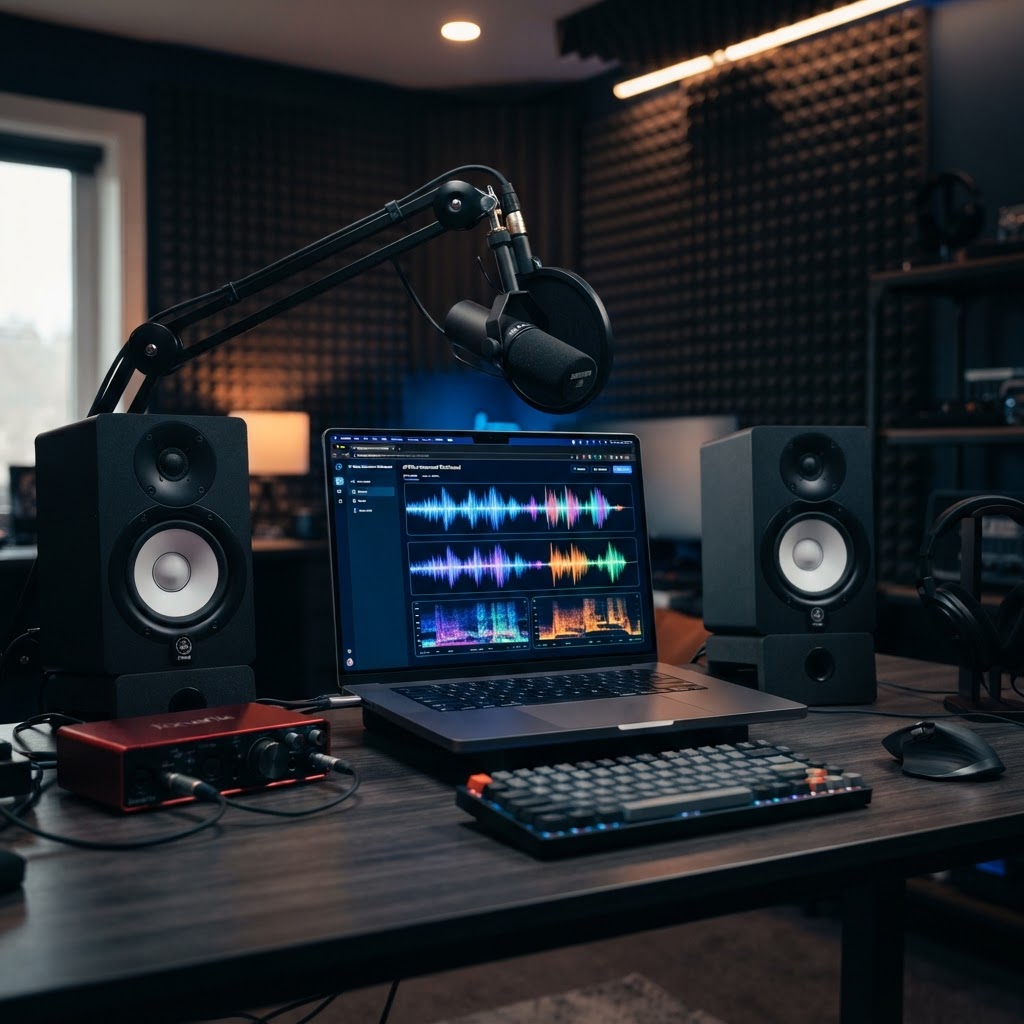
- Neural synthesis technology has reached near-human parity, effectively blurring the lines between studio-recorded audio and synthetic speech.
- ElevenLabs leads the market in emotional resonance and high-fidelity vocal expressivity, setting the current industry standard.
- Murf AI prioritizes workflow integration for professional teams, focusing on the specific needs of corporate training and e-learning developers.
- Play.ht specializes in seamless web integration, making it the premier choice for publishers looking to convert articles into audio on the fly.
- Selecting the best AI voice generator in 2026 requires balancing output quality, latency, API accessibility, and specific use-case scalability.
The landscape of artificial intelligence has shifted dramatically over the past few years, moving from simple, robotic text-to-speech outputs to nuanced, emotive vocal performances that are frequently indistinguishable from human talent. As we navigate through 2026, the demand for high-quality audio has surged across the creator economy, enterprise sectors, and web publishing. Today, finding the best AI voiceover software is no longer just about selecting a service that sounds “clear”—it is about finding a platform that captures the precise intonation, cadence, and breath control required for specific professional contexts. In this deep dive, the aismarttoolsreview Editorial Team analyzes the three industry titans—ElevenLabs, Murf AI, and Play.ht—to determine which tools define the current state of the art in text to speech AI.
Evolution of Text-to-Speech Technology in 2026
The trajectory of synthetic speech has moved at a staggering pace. A decade ago, TTS (text-to-speech) systems were primarily concatenation-based, stitching together recorded phonemes in a way that left unnatural artifacts and robotic gaps. By the early 2020s, neural networks entered the fray, allowing for more fluid transitions between sounds. Now, in 2026, we have reached the era of generative prosody. Modern systems no longer merely “read” text; they interpret the semantic structure of a sentence to infer context, urgency, and underlying intent.
Early iterations of neural voice synthesis struggled with “long-form fatigue,” where listeners would quickly identify the synthetic nature of the audio after a few minutes of exposure. Today’s AI audio tools mitigate this through advanced transformer-based architectures that maintain consistent voice character over thousands of words. Furthermore, the integration of Large Language Models (LLMs) with TTS engines has revolutionized how these systems process punctuation, sarcasm, and complex formatting. Where previous systems treated a comma as a binary pause, current models perceive a comma as a shifting point in breathing and tonal elevation. This evolution is particularly visible in the refinement of realistic AI voices. We have moved past the “uncanny valley,” where synthetic voices were eerily close but ultimately flawed. Instead, we are entering a phase where the AI adds “vocal imperfections”—a slight tremor here, a quick intake of breath there—that trick the human brain into perceiving a biological entity. This evolution has democratized audio production; independent creators can now achieve broadcast-quality narration without the overhead of physical studio time or professional voice actors. As we look at the 2026 landscape, the focus has shifted from the mere ability to generate speech to the capability to control that speech with granular precision, enabling users to direct the AI’s “performance” just as a film director would work with a human talent on a soundstage.
Understanding Neural Voice Cloning and Synthesis
At the heart of the AI voice generator revolution is the distinction between synthesis and cloning. While they share technological roots, their applications differ significantly. Neural voice synthesis refers to the generation of entirely new voices—AI-modeled personalities that never existed in the physical world. These models are trained on thousands of hours of high-quality speech data to learn the vast spectrum of human phonetic distribution. Conversely, voice cloning involves taking a short snippet of a specific human’s voice—often as little as a few seconds or a minute of clean, dry audio—and mapping its unique timbre, pitch, and inflection patterns onto a synthetic architecture.
The mechanics behind this involve sophisticated deep learning processes, primarily utilizing Variational Autoencoders (VAEs) and Generative Adversarial Networks (GANs). The system decomposes the audio into a latent space representation, essentially breaking the voice down into mathematical coordinates that describe how that specific voice moves from one sound to another. When a user inputs text, the model uses these learned parameters to reconstruct speech that mirrors the subject’s original vocal signature. In 2026, the barrier to entry for high-fidelity cloning has dropped significantly. We are no longer limited to “generic” cloning; we can now clone a specific voice while maintaining the ability to adjust emotional outputs—meaning a cloned voice can sound happy, distressed, or professional depending on the user’s requirements.
However, this technology comes with significant ethical and technical considerations. The ability to create perfect vocal replicas requires robust safeguards, and leading platforms have implemented extensive verification protocols to ensure that cloning is performed only with consent. From a technical standpoint, the quality of a clone is intrinsically linked to the “cleanliness” of the source audio. Background noise, reverb, and low bitrates are the primary enemies of high-quality synthesis. Experts often recommend using dedicated, studio-grade recording equipment even for short samples, as the AI will amplify not just the vocal traits but also the acoustic environment of the original recording. As these tools continue to mature, the focus is shifting toward “real-time” cloning, where systems can mimic voices during live broadcasts or interactive gaming sessions, providing an immersive experience that was previously relegated to science fiction. Understanding these fundamentals is crucial for any user looking to leverage these tools for professional, legal, or creative projects, as the specific “flavor” of the synthesis architecture often dictates which platform is best suited for your particular workflow.
| Platform | Core Strength | Best For |
|---|---|---|
| ElevenLabs | Emotional depth & expressivity | Storytelling, narration, & high-end content |
| Murf AI | Studio-grade project management | E-learning & corporate training presentations |
| Play.ht | Web integration & API accessibility | Publishers & automated web content |
ElevenLabs: High-Fidelity Voice Synthesis Capabilities
When conducting an ElevenLabs review, it becomes immediately apparent why this platform has become the gold standard for creative professionals. ElevenLabs has arguably the most advanced understanding of “performance” in the current AI market. Unlike traditional systems that treat a text input as a monotone string of words, ElevenLabs focuses on contextual awareness. The software’s ability to interpret punctuation and sentence structure creates an output that breathes—literally and figuratively. The pauses are not fixed durations but variable intervals that mimic the natural flow of a professional narrator.
The platform’s standout feature, Voice Design and Cloning, allows for an unprecedented level of creative freedom. Users can tweak the stability, clarity, and style exaggeration of any voice, effectively giving them a “mixing console” for speech. If you need a voice that sounds slightly more fatigued for a dramatic narrative or a voice that is energetic and bright for a promotional video, these parameters allow for a level of micro-management that competitors often lack. Furthermore, ElevenLabs has integrated advanced speech-to-speech workflows, where a user can record their own voice, and the AI will “re-skin” the recording with the target persona while retaining the user’s original intonation and timing. This is a game-changer for content creators who need the exact delivery of their own acting but require the professional voice quality of a studio talent.
From a usability perspective, the interface is streamlined for efficiency. It does not clutter the user experience with unnecessary production tools; instead, it focuses on providing a high-output environment for audio generation. The API implementation is also exceptionally clean, making it a favorite for developers building custom applications that require natural language response. Whether it is for high-quality audiobooks, gaming NPCs, or dynamic marketing scripts, ElevenLabs consistently demonstrates that its neural engine is ahead of the curve in terms of raw audio quality. The nuance it brings to non-English languages is also worth noting; by training on diverse datasets, the system handles regional accents and dialectal variations with a grace that few others can match. For anyone prioritizing the “human” feel of the audio, ElevenLabs remains the primary recommendation.
Murf AI: Best Features for Corporate and E-learning
While ElevenLabs dominates in expressive storytelling, Murf AI occupies a unique space as the powerhouse for corporate and educational content. For professional users who need more than just raw audio generation—specifically those requiring complex project management—Murf AI vs Play.ht comparisons often tilt toward Murf because of its dedicated “Studio” environment. Murf is designed as an end-to-end audio production suite. It allows users to synchronize audio directly with visual assets, such as slides or videos, within the interface. This capability eliminates the need for third-party video editors in the early stages of project development, making it an essential tool for instructional designers.
The platform excels in managing team-based workflows. In an enterprise setting, multiple stakeholders often need to review, edit, and approve scripts and voiceovers. Murf AI’s collaboration features allow for shared workspaces, version history, and role-based access, which are critical for maintaining brand consistency across a company’s training modules. The voices themselves are meticulously curated to sound professional, authoritative, and clear—the specific attributes desired for e-learning. While they may not offer the extreme “emotional range” of some niche storytelling tools, they provide a level of consistency and reliability that is essential when creating hours of educational material where the voice quality must remain uniform.
Another area where Murf AI shines is in its handling of long-form projects. The interface is optimized to manage large batches of text, allowing for easy bulk-generation and granular adjustments to speed, pitch, and emphasis on individual phrases. If a project requires specific terminology—such as medical, technical, or legal jargon—Murf’s pronunciation library allows users to override standard AI outputs to ensure names and acronyms are spoken correctly every time. This attention to detail is what makes it the go-to for corporate training departments. The integration with Canva and other presentation tools further simplifies the workflow, allowing users to move from script to finished multimedia presentation in a fraction of the time it would take using traditional recording methods. By prioritizing utility and efficiency, Murf AI effectively bridges the gap between sophisticated AI technology and the practical constraints of professional corporate communication.
Play.ht: Integrating AI Audio into WordPress and Web Apps
For web publishers, bloggers, and digital product developers, Play.ht offers a distinct value proposition. Unlike platforms that focus primarily on content creation for offline media, Play.ht is built with the web in mind. It is arguably the best solution for converting text-heavy websites into audible experiences, which is increasingly important for accessibility compliance and audience engagement in 2026. Through its robust WordPress plugin and customizable audio widgets, Play.ht allows any content site to offer an “audio version” of its articles with a single click.
The integration capabilities of Play.ht are the hallmark of its service. Its API is highly efficient and designed for developers who want to integrate text to speech AI directly into their web applications or mobile products. This makes it an ideal choice for apps that need real-time audio generation, such as news aggregation services or interactive educational platforms. The ability to cache audio files generated by Play.ht also means that websites don’t suffer from high latency; once an article is generated, it serves as a static asset, ensuring the user experience is smooth even on slower connections. Furthermore, the platform offers deep customization for its audio players. Publishers can brand their audio experience to match their site’s theme, providing a cohesive look that feels native to the reader’s environment.
Beyond its technical integration, Play.ht has invested heavily in voice diversity. They host a wide array of voices that are tuned specifically for informative, factual delivery—the type of voice you would expect from a news anchor or a lecturer. While these voices are excellent for storytelling, they are specifically optimized for clarity. This ensures that even complex topics are easy to follow when listening at high speeds. The platform also includes comprehensive analytics, allowing site owners to track how many users are clicking on the audio versions, which articles are most popular in audio form, and how much time users are spending engaged with the audio content. This data-driven approach helps content creators refine their output to better suit their audience’s consumption habits. By focusing on the intersection of web content and audio, Play.ht has established itself as the standard-bearer for digital publishers who want to leverage the power of audio to expand their reach and improve user retention.
Comparing Voice Customization and Emotional Range
The hallmark of a high-quality AI voice generator in 2026 is no longer just the absence of robotic artifacts; it is the ability to convey nuance. Modern text-to-speech AI has moved beyond simple phonetic delivery into the realm of performance. When evaluating ElevenLabs, Murf, and Play.ht, users must distinguish between structural customization and emotional dexterity.
ElevenLabs currently leads the market in what developers call “prosodic expressivity.” Their platform utilizes advanced architecture that models the biological constraints of human speech, such as inhalation patterns, micro-pauses for dramatic effect, and the natural trailing off of sentences. For users seeking a cinematic or storytelling quality, ElevenLabs provides a “Stability” and “Clarity” slider that functions as a gatekeeper for emotional volatility. Lowering stability often unlocks more erratic, performance-heavy intonations, while increasing it results in a reliable, steady broadcast voice.
Murf AI takes a different approach by focusing on “granular performance control.” Rather than relying solely on the model’s interpretation of your text, Murf provides an interface that allows for specific pitch adjustments, speed modification, and emphasis placement on a per-word basis. This is particularly advantageous for corporate training videos or E-learning modules where a specific cadence is required for clarity. While Murf may lack the “raw” performance soul of ElevenLabs, its predictable nature makes it a superior tool for technical documentation or instructional design.
Play.ht has carved a niche in the high-fidelity space with its Ultra-Realistic voice models. These models are engineered to handle complex punctuation and multi-lingual context clues better than most competitors. If your script involves technical jargon mixed with emotional dialogue, Play.ht often requires the least amount of “prompt engineering” or manual adjustment to sound professional. Its strength lies in its consistency across long-form content, making it a favorite for publishers looking to automate audio versions of articles or newsletters.
| Tool | Primary Customization Focus | Emotional Range Style | Best For |
|---|---|---|---|
| ElevenLabs | Neural performance variables | High-volatility, dramatic, cinematic | Content creators & entertainment |
| Murf AI | Pitch, emphasis, & pause control | Steady, clear, instructional | Corporate & E-learning |
| Play.ht | Contextual synthesis | Balanced, professional, consistent | Publishing & long-form audio |
Pricing Models for AI Voice Generation Tools
The pricing landscape for the best AI voiceover software has matured significantly by 2026. Most providers have transitioned away from one-size-fits-all subscription models toward usage-based tiers that account for the high computational costs of generating high-fidelity audio. Understanding these models is critical for budgeting, especially when scaling a business.
Most platforms operate on a “character count” model rather than a time-based model. It is important to note that a “character” typically includes spaces and formatting symbols. If you are generating long-form content, such as audiobooks or podcasts, these character quotas can be consumed faster than anticipated. ElevenLabs offers a tiered subscription system where higher-cost plans provide access to higher-quality models and faster rendering speeds. Their focus is on enabling professional creators to scale their output while maintaining a consistent “voice identity.”
Murf AI focuses on collaborative workflows. Their pricing structure often includes “seats” or “user slots,” which is a distinct advantage for teams working on complex video productions. When you pay for a Murf subscription, you are often paying for the integrated editor, which acts as a simplified digital audio workstation (DAW). This is a vital distinction: you are not just paying for a voice generator; you are paying for an audio production environment.
Play.ht has historically leaned toward enterprise-friendly pricing, offering specialized tiers for API access. This is essential for developers integrating AI audio into mobile apps, smart devices, or websites. While their entry-level plans are competitive for individual bloggers, their real value proposition becomes apparent at the higher tiers where commercial usage rights and high-speed synthesis become standard. Before committing to a plan, potential users should calculate their monthly output in thousands of characters and test if the specific “pro” voice models required for their brand are gated behind the most expensive subscription tiers.
Licensing and Copyright Considerations for AI Audio
Navigating the legal landscape of AI-generated content is a primary concern for agencies and enterprise users. The core question is: who owns the audio, and who owns the voice? In 2026, the industry standard has largely coalesced around a clear distinction between the “voice model” and the “output.”
Most top-tier AI voice generators grant you full commercial usage rights for the audio files you create, provided you are on a paid subscription tier. This means you can monetize the audio via ads, distribute it on streaming platforms, or use it in marketing materials without paying royalties to the underlying voice actor. However, this is distinct from “voice cloning.” When you clone a voice, you must ensure that you have explicit consent from the person being cloned. The major platforms have robust security protocols to prevent users from cloning public figures or private individuals without authorization. Attempting to bypass these safeguards is a violation of Terms of Service and can result in immediate account termination and legal exposure.
Another layer to consider is the “Public Domain” versus “Synthetic” status. While the AI-generated audio is generally considered your property, it is currently difficult to “copyright” the output in many jurisdictions because the work is created by an algorithm. This means that while you own the commercial rights to use the audio, a competitor might theoretically be able to reproduce a similar output if they possess the same model and settings. For businesses, this highlights the importance of keeping your specific voice settings and prompt workflows as part of your proprietary intellectual property.
How to Choose the Best AI Voice for Your Brand
Choosing the right voice is a brand-defining decision akin to choosing a logo or a color palette. An AI voice is the “sonic personality” of your organization, and inconsistency can confuse your audience. To choose the best AI voiceover software for your brand, follow this systematic approach:
- Define Your Brand Persona: Before touching the software, write down the three core traits of your brand’s voice. Is it “Authoritative and Serious,” “Casual and Playful,” or “Warm and Empathetic”? This filter will drastically narrow down your library choices.
- Test for “Fatigue Factor”: Listen to a five-minute audio sample generated by the candidate voice. If your ears feel strained or if the voice sounds repetitive after two minutes, it is likely not suitable for long-form content.
- Multilingual Requirements: If your brand operates globally, ensure the platform supports high-fidelity accent localization. Many AI tools sound natural in English but struggle with the cadence of secondary languages. Test the voice with specific local idioms relevant to your target demographic.
- Integration Testing: Does your workflow involve third-party tools like Adobe Premiere, Canva, or a proprietary CMS? Check if the AI provider offers an API or a plugin that allows you to generate audio directly within your existing workflow.
- Commercial Scalability: Ensure the licensing agreement for your chosen voice allows for “perpetual use.” You do not want to build a brand around a specific synthetic voice only to find that your subscription tier does not cover the legal rights for broadcast advertisements.
Future Trends in AI Voice and Synthetic Media
As we look toward the latter half of 2026 and beyond, the AI voice industry is moving rapidly toward “Multimodal Synthesis.” We are reaching a point where audio is no longer just text-to-speech, but a bridge between video and intent. Soon, voice generators will be able to synchronize audio with video lip-syncing in real-time, effectively automating the entire dubbing and localization process for global media.
Another emerging trend is the rise of “Adaptive Audio environments.” Instead of static files, future AI audio will react to the environment of the listener. For instance, in a gaming context, the voice might modulate its tone based on the proximity of other objects in the game world, or in a podcast, the AI might adjust its breathing patterns based on the intensity of the background music. The synthesis of voice is becoming less about “reading text” and more about “simulating an actor in a scene.”
Furthermore, we are seeing the democratization of “Voice Banking.” This technology, once reserved for those with degenerative medical conditions, is becoming a standard feature of personal AI assistants. In the near future, you will likely be able to create a digital version of your own voice that acts as a brand ambassador, recording content while you sleep or managing customer service inquiries with your own vocal signature.
Frequently Asked Questions
Can I use AI-generated voices for YouTube monetization?
Yes, most reputable AI voice platforms allow you to monetize your content on platforms like YouTube. However, YouTube’s policies often require that you disclose the use of AI. It is recommended that you check both the platform’s specific terms of service and ensure you are on a paid commercial subscription tier to avoid any copyright disputes regarding the audio.
Do AI voices sound like real humans in 2026?
Modern AI voices are virtually indistinguishable from human beings in short-to-medium-length clips. While there are still rare instances where an AI might struggle with extremely obscure proper nouns or highly technical medical terminology, for the vast majority of commercial applications, the audio quality is indistinguishable from professional studio-recorded voiceovers.
How do I make an AI voice sound less robotic?
The secret to eliminating the “robotic” feel is to manipulate the punctuation and prosody. Adding subtle pauses using commas or dashes can mimic the natural cadence of human thought. Additionally, using tools that allow you to adjust the “stability” or “style exaggeration” sliders will help the AI prioritize performance and emotion over perfect, clinical articulation.
Is ElevenLabs better than Murf for beginners?
ElevenLabs is generally considered more intuitive for those who want immediate, high-quality results with minimal effort due to its sophisticated model training. Murf is better suited for users who need a comprehensive production suite. If you are a beginner who just needs a voiceover, ElevenLabs has a faster learning curve, whereas Murf is better if you need to sync audio with video slides.
Can I clone my own voice legally?
Yes, you can legally clone your own voice for personal or commercial use. Most platforms have a verification process where you must record a script provided by the platform to prove that the voice you are cloning is actually your own. Once verified, you maintain ownership over the synthetic version of your voice.
What happens if I stop paying my AI voice subscription?
If you cancel your subscription, you generally retain the rights to the files you generated while your account was active. However, you typically lose access to the generation tools and the ability to download new audio. Always back up your generated files to your local storage, as some platforms may purge old assets after a period of account inactivity.
Conclusion
The landscape of AI voice generation in 2026 is defined by unprecedented realism and ease of use. Whether you opt for the raw expressive power of ElevenLabs, the structural precision of Murf AI, or the balanced consistency of Play.ht, the barrier to entry for high-quality audio production has effectively evaporated. Your choice should ultimately depend on your specific workflow needs, team size, and the emotional requirements of your target audience.
As these tools continue to evolve, staying updated with the latest features—such as real-time voice shifting and video integration—will be key to maintaining a competitive edge. Do not let your brand fall behind in the sonic revolution; start by signing up for a free trial on one of these platforms today and begin experimenting with the future of your brand’s voice.
By aismarttoolsreview Editorial Team
Leave a Reply