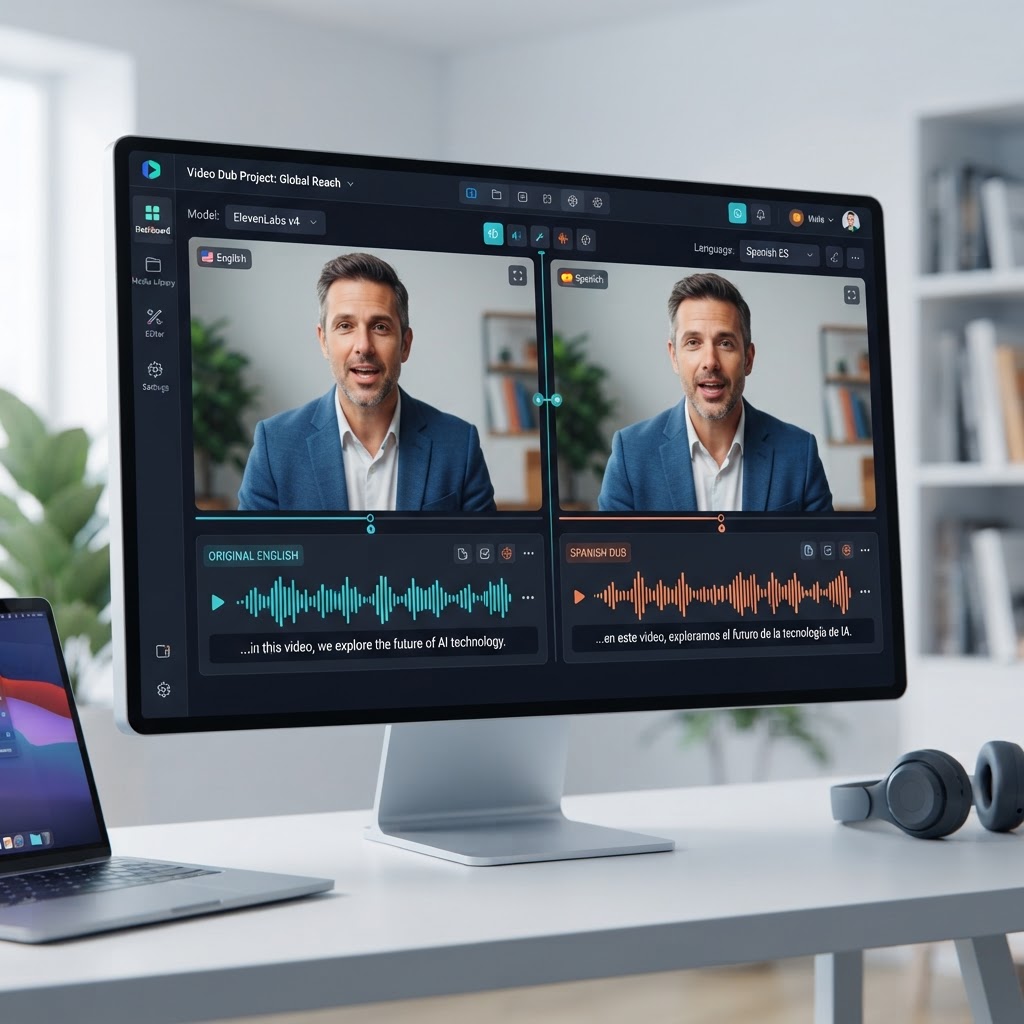
- AI video dubbing has evolved from robotic, monotone synthesis to highly emotive, context-aware speech generation.
- Localization workflows now integrate automatic voice translation with lip-sync AI, significantly reducing production time for global audiences.
- ElevenLabs leads in vocal nuance and cloning quality, whereas Rask.ai excels in workflow management for professional creators.
- HeyGen remains the industry benchmark for visual realism, utilizing advanced lip-sync AI to match translated audio with original speaker movements.
- Choosing the right tool depends on your priority: voice fidelity, full-project localization efficiency, or visual avatar replacement.
The landscape of digital content consumption is undergoing a radical shift as the barriers to global communication dissolve. By 2026, the demand for high-quality, multilingual content has moved beyond simple subtitling, driving creators and enterprises toward sophisticated AI video dubbing solutions. No longer restricted by the high costs of traditional studio dubbing, independent creators and global brands alike are leveraging automatic voice translation to repurpose their intellectual property for international markets. This shift represents more than just a convenience; it is a fundamental redefinition of how video content scales, allowing a single creator in a local studio to reach audiences in dozens of languages simultaneously while maintaining the original performance’s emotional intent.
The Rise of AI-Powered Video Localization in 2026
Video localization has transitioned from a niche service reserved for major film studios to an accessible, high-performance necessity for any content strategy. In 2026, we are witnessing the maturation of generative models that do not merely translate words but preserve the prosody, accent, and emotional inflection of the original speaker. This evolution is the backbone of modern video localization, enabling creators to transcend linguistic borders without sacrificing the authenticity of their narrative.
Historically, reaching a non-native audience meant settling for static, often poorly synced subtitles that rarely conveyed the tone of the speaker. Modern AI video dubbing tools have changed this dynamic by offering a seamless marriage between linguistic accuracy and auditory naturalism. The primary catalyst for this shift is the integration of advanced speech-to-speech models that analyze the acoustic signature of the source audio. Instead of a generic synthesis, the software produces a voice that sounds like the original actor, even when speaking a language they do not know.
Furthermore, the rise of these tools is fueled by the economic reality of the creator economy. Producing high-end localized content once required booking international recording studios and sourcing specialized voice actors. Today, the best AI dubbing tools allow for the batch processing of long-form video content, effectively turning an hour-long documentary into a localized asset in a fraction of the time. The infrastructure now supports nuances such as timed pauses, emphasis on specific keywords, and background noise preservation, which is vital for maintaining the immersive quality of the original video. As search engines and social platforms prioritize multilingual content, adopting these tools is no longer optional for those seeking to maximize their global reach.
How AI Dubbing Technology Works for Creators
The architecture behind AI video dubbing is a multi-layered pipeline that typically involves three distinct technical stages: transcription, translation, and generative synthesis. To appreciate why specific tools stand out, creators must understand how these processes interact. First, the source video undergoes high-precision automatic speech recognition (ASR). This transcript must be granular, capturing not just words but timing, silences, and laughter, as these metadata points are essential for the final polish.
Once the text is captured, it is translated through LLM-powered engines designed specifically for cultural localization rather than literal translation. A literal translation often fails to account for idioms, slang, or regional variations that can make a video feel artificial. The translation layer must be context-aware, ensuring that the dubbed audio matches the timing of the original video. This brings us to the most complex part of the process: generative voice synthesis. Here, the system uses “voice cloning” technology to create a digital twin of the speaker’s voice. By analyzing the original audio’s timbre and cadence, the software maps these characteristics onto the translated target language.
Finally, the process concludes with lip-sync AI, which modifies the visual aspect of the video. The most advanced systems use neural rendering to slightly adjust the mouth movements of the subject to match the new phonemes of the target language. This is where the gap between high-end professional tools and standard apps becomes apparent. While basic tools might simply layer audio over video, advanced solutions manipulate the pixel data to ensure the speaker’s articulation looks natural. This holistic approach ensures that the localized video does not suffer from “uncanny valley” effects, keeping the viewer’s attention focused on the content rather than the artificial nature of the dubbing.
| Tool | Primary Strength | Best For |
|---|---|---|
| ElevenLabs | Voice Fidelity & Emotional Range | Audio-first projects and high-fidelity cloning. |
| Rask.ai | Workflow Automation | Complex multi-language video localization pipelines. |
| HeyGen | Visual Lip-Sync Integration | Video projects requiring perfect facial synchronization. |
ElevenLabs: High-Fidelity Voice Cloning and Dubbing
ElevenLabs has established itself as the gold standard for pure auditory quality in the AI dubbing market. When evaluating the best AI dubbing tools, it is impossible to overlook their proprietary generative engine, which excels at capturing the “soul” of a speaker’s voice. Unlike systems that focus solely on the text-to-speech aspect, ElevenLabs excels in the ability to retain the emotional cadence of the original performance, making it an ideal choice for filmmakers, podcasters, and long-form video creators who demand high-fidelity output.
The core technology behind their dubbing suite is their advanced voice cloning capabilities. By analyzing a relatively small set of clean audio samples, the engine creates a digital profile that mimics the nuances of the speaker—including soft breaths, pitch variations, and specific speech patterns. For creators looking to localize professional interviews or character-driven content, this capability is invaluable. The software handles multilingual translation with a high level of grammatical sophistication, but its true prowess lies in the prosody of the output. When translated text is injected into the engine, the output consistently avoids the “monotone trap” that plagues lesser synthesis software.
Furthermore, ElevenLabs offers deep control over the dubbing environment. Users can adjust settings for stability, clarity, and style exaggeration. This level of technical granularity is what attracts power users. You aren’t just getting an AI subtitle generator; you are getting a sophisticated audio production tool that allows for “prompt-based” emotional direction. If a particular line of translated dialogue feels too flat, you can steer the model toward a more dramatic or inquisitive tone. This flexibility is what positions ElevenLabs at the forefront of the industry for creators who prioritize the auditory experience as the cornerstone of their brand identity.
Rask.ai: The All-in-One Localization Workflow
While ElevenLabs focuses on the precision of the voice, Rask.ai is engineered for the precision of the process. For content creators managing multiple channels or large-scale video projects, Rask.ai functions less like a tool and more like an automated production studio. It excels by providing an end-to-end environment that handles everything from the initial transcription of raw footage to the final, ready-to-publish localized video file, complete with professional-grade subtitle generation.
What makes Rask.ai particularly powerful for the 2026 creator is its capacity for multi-speaker management. In scenarios involving podcasts or panel discussions, the software can differentiate between individual voices, apply unique voice clones for each participant, and maintain those identities across the entire translation process. This is a significant bottleneck in manual video localization, and Rask.ai’s ability to automate this at scale makes it a favorite for enterprise content teams and high-output YouTubers. The dashboard is designed for speed, allowing users to upload a single file and have it processed for multiple target languages simultaneously.
Additionally, the software integrates a robust AI subtitle generator that is aware of the video’s context. Rather than just transcribing words, Rask.ai synchronizes the subtitle timing with the speaker’s cadence, providing a clean, readable, and highly accurate output that adheres to international subtitling standards. The platform’s philosophy is built on removing the friction of the “localization pipeline,” meaning users can spend less time editing audio files and more time planning content strategy. By combining high-quality synthesis with an intuitive project management dashboard, Rask.ai bridges the gap between raw video footage and a fully localized global asset with impressive reliability.
HeyGen: Visual Lip-Sync and Avatar Integration
If the visual aspect of your video is paramount, HeyGen is currently setting the bar for lip-sync AI integration. While other tools excel at audio synthesis, HeyGen is uniquely positioned to handle the visual reconstruction of the speaker’s mouth movements to align perfectly with the translated language. For creators producing training content, corporate presentations, or marketing videos where the subject is “on camera,” HeyGen provides a layer of realism that standard audio-only dubbing cannot replicate.
The strength of HeyGen lies in its sophisticated neural rendering engine. When you feed a source video into the platform, it doesn’t just overlay a new language track; it performs a deep analysis of the speaker’s facial geometry. During the synthesis phase, the engine modifies the mouth and jaw movements of the original actor to match the phonemes of the new language. This solves the persistent problem of “visual dissonance,” where the viewer sees the speaker’s mouth moving to English words while hearing Spanish or Japanese, which can break the immersion of the viewer.
Beyond visual synchronization, HeyGen offers a highly robust avatar integration system. For companies that utilize AI-generated presenters, HeyGen allows for a seamless “face-swap” or avatar lip-sync that makes the speaker appear as though they are native speakers of every language in the distribution list. This level of technical sophistication is particularly impactful for e-learning platforms and global product launches. The software handles the nuances of regional accents with impressive fidelity, ensuring that the visual experience matches the professional tone of the audio. By focusing on the synergy between facial performance and linguistic accuracy, HeyGen has become the go-to solution for creators who cannot afford for their content to look “dubbed.”
Comparing Accuracy: Language Support and Dialect Handling
The core of effective AI video dubbing lies in the nuance of language. While machine translation has made monumental leaps, the delta between a literal translation and a localized experience remains vast. When evaluating ElevenLabs, Rask, and HeyGen, the distinction often comes down to how these engines handle morphological variations, slang, and cultural context.
ElevenLabs has established a reputation for its sophisticated prosody. Its strength is not just in vocabulary mapping, but in the emotional cadence of the output. When dealing with complex languages like Japanese or Arabic, where politeness levels and gendered verb forms are critical, ElevenLabs often manages to maintain the intent of the speaker better than generic tools. However, its primary focus remains audio synthesis; it excels at mimicking the cadence of the original speaker, which is a massive boon for brand consistency.
Rask.ai, conversely, is purpose-built for localization workflows. It offers a more robust library of languages, particularly those that are often neglected by smaller developers. In terms of dialect handling, Rask allows for granular control over the output, enabling creators to distinguish between, for instance, Peninsular Spanish and Mexican Spanish. This is a critical distinction for enterprises that need to avoid the “pan-Hispanic” trap, which can often sound robotic or unnatural to native speakers.
HeyGen integrates lip-syncing into the language equation, which complicates the accuracy metric. It is not enough for the audio to be correct; it must match the visual cues of the lips. HeyGen’s engine prioritizes visual alignment, which occasionally necessitates slight phrasing adjustments to match syllable counts. While this can lead to minor departures from the source text, the visual immersion often compensates for the linguistic shift.
Dialect handling remains the final frontier for all three platforms. In many instances, the AI defaults to a “Standard” version of a language. Users requiring deep, regional localization will likely need to employ a “human-in-the-loop” strategy, where a native speaker reviews the AI-generated output to catch localized idiomatic errors that the model might otherwise overlook.
| Tool | Dialect Customization | Context Awareness | Best For |
|---|---|---|---|
| ElevenLabs | Moderate | High (Emotional/Prosodic) | Narrative and storytelling content |
| Rask | High | High (Linguistic Accuracy) | Marketing and long-form education |
| HeyGen | Moderate | Moderate (Visual alignment priority) | Video avatars and corporate comms |
Speed vs Quality: Managing the Post-Production Process
The primary value proposition of AI video dubbing is the reduction of traditional post-production time. A project that would typically require weeks of studio scheduling, voice actor casting, and sound engineering can now be executed in hours. However, the speed-to-quality ratio remains a delicate balancing act for production teams.
For high-velocity content creators, such as YouTube vloggers or short-form social media agencies, the goal is often “good enough.” In these scenarios, Rask.ai’s “one-click” localization workflow is unmatched. It automates the transcription, translation, and voice dubbing stages in a single pipeline. The trade-off is that these rapid outputs occasionally miss nuanced emotional beats, and if the original speaker’s audio was noisy, the resulting dub may suffer from artifacts or slight clipping.
When the stakes are higher—such as in corporate training modules or high-end documentary filmmaking—the post-production process requires a more iterative approach. ElevenLabs is frequently favored here because it provides granular control over the audio generation parameters. By adjusting stability, clarity, and exaggeration settings, a professional sound editor can polish the audio to a standard that rivals human recording sessions. This requires more time, but the outcome is a much more polished asset.
HeyGen sits in a unique middle ground. Because it modifies the facial structure of the subject to match the new language, the post-production workflow often involves fixing “visual glitches.” If the AI struggles with a certain phoneme, the visual result can be an uncanny or distorted lip movement. Professional teams typically use HeyGen for its initial render and then leverage video editing software to cut around the moments where the AI synchronization is less than perfect. This workflow ensures that the final video looks and sounds authentic without requiring a complete re-shoot.
Pricing Structures and Cost-Effectiveness for Businesses
Enterprise budgets are rarely bottomless, and the cost-effectiveness of AI dubbing tools depends on the scale of deployment. Understanding the pricing models of ElevenLabs, Rask, and HeyGen is essential for CFOs and production leads.
ElevenLabs utilizes a character-based subscription model. This is inherently scalable for teams that produce varying amounts of audio content. Because it does not rely on video processing, the cost is tied strictly to the depth of the audio library. For businesses that are already heavy users of AI voice for podcasts or audiobooks, adding video dubbing via ElevenLabs is often a value-add that does not disrupt the existing budget allocation.
Rask.ai typically follows a project-based or tier-based model that accounts for total video duration. This makes it highly predictable for businesses that produce a consistent volume of video content per month. Companies benefit from the platform’s comprehensive nature; you pay for the entire localization pipeline—subtitles, translation, and audio—which often works out to be significantly cheaper than managing separate vendors for each of these tasks.
HeyGen is often positioned as a premium tool because it involves heavy server-side GPU usage for visual generation. Pricing is typically tiered based on the number of “credit” minutes. For startups and enterprises looking to leverage video avatars as a primary communication method, this cost is easily justified by the elimination of video production costs. However, for a high-volume media company looking to dub hundreds of hours of archival footage, the credit costs of HeyGen may become prohibitive, leading many to utilize it only for specific, high-visibility assets.
Common Challenges in Automated Video Translation
Even with advanced technology, automated video translation is not without its pitfalls. One of the most common challenges is “duration mismatch.” Different languages express concepts in different lengths. A sentence that takes three seconds to say in English might take five seconds in German. If the AI is not smart enough to handle the pacing, the audio will either finish early, creating an awkward silence, or run over the visual cut, causing a jarring transition.
Another persistent challenge is the “context vacuum.” Large Language Models (LLMs) used in translation are incredibly capable, but they lack the real-world visual context of the video. They may translate a phrase literally without realizing that the speaker is holding an object or gesturing toward a specific point on a map. Without a visual-aware translation layer, these mismatches can lead to confusion for the viewer.
Technical artifacts also remain a concern. Background noise, music, and ambient sounds in the original clip often clash with the generated voice track. Removing these without stripping the “life” out of the audio is a significant technical hurdle. Most platforms attempt to isolate the voice, but the resulting “dry” audio can sometimes sound floating or disconnected from the environment depicted on screen.
Finally, there is the risk of cultural misinterpretation. An AI may provide a grammatically correct translation that uses inappropriate honorifics or tones for a specific target culture. While the software understands the words, it cannot always read the social room. This highlights the ongoing necessity for human oversight in any serious global content strategy.
Choosing the Right Tool for Your Global Content Strategy
Selecting the optimal tool requires a sober analysis of your content objectives. If your strategy is centered on rapid experimentation and A/B testing across multiple international social platforms, Rask.ai is likely your strongest candidate. Its ecosystem is designed for speed and platform-agnostic distribution, making it ideal for the “always-on” creator economy.
If your priority is brand voice and high-quality storytelling—where the emotional connection between the narrator and the audience is paramount—ElevenLabs is the industry leader. It is the tool for businesses that care deeply about the texture of the voice and the pacing of the narrative. It is effectively the “audio-first” choice in an increasingly visual world.
If you are exploring the future of remote communication, where AI avatars are replacing traditional on-camera presenters, HeyGen is the definitive choice. It is not just about dubbing; it is about visual transformation. If your content strategy involves creating internal corporate training, personalized sales outreach, or global educational modules, HeyGen’s ability to modify the visual performance creates a level of engagement that standard dubbing cannot replicate.
The most successful global strategies often involve a hybrid approach. Many high-performing organizations use HeyGen for executive announcements where a consistent brand face is needed across all regions, while employing ElevenLabs for character-driven narrative content. By matching the tool to the specific requirement of the video asset, teams can maximize both quality and ROI.
Frequently Asked Questions
Is AI video dubbing truly as accurate as professional human voice-over work?
While AI has reached a high level of fidelity, it does not yet match the contextual, emotional, and social awareness of a professional human voice actor. AI is excellent for high-volume, cost-effective localization, but for high-stakes brand messaging or highly sensitive content, human voice talent remains the gold standard.
Do these AI tools automatically remove background music from my original video?
Most advanced dubbing tools, including Rask.ai and ElevenLabs, include source separation technology. They can identify and isolate the human voice while suppressing background music, though the quality of the separation often depends on the complexity of the original audio track.
Can I retain the original speaker’s voice in a different language?
Yes, all three mentioned platforms offer “voice cloning” or “voice synthesis” features. This allows the AI to learn the unique timbre and cadence of your original speaker and apply it to the translated audio, ensuring a consistent brand identity across all language versions.
Is lip-syncing mandatory for all AI-dubbed videos?
Lip-syncing is not mandatory. Many creators choose “voice-over” style dubbing, where the original video remains unchanged and the translated audio is simply layered over the top. Lip-syncing is primarily used for “talking head” videos where the viewer expects the speaker’s mouth to align with the spoken words.
How does AI handle non-verbal cues like laughter or sighs?
Top-tier AI dubbing tools have begun incorporating “emotional metadata” into their models. While they can now replicate simple cues like laughter or dramatic pauses, complex emotional nuances still occasionally require manual intervention or sound engineering tweaks to sound entirely natural.
What is the biggest risk when using AI for global content localization?
The primary risk is the loss of cultural nuance. A translation may be technically correct but socially inappropriate if the AI does not understand the local context. Businesses should always perform a “cultural audit” on AI-translated content before pushing it to a public, global audience.
Conclusion
The landscape of global communication is shifting beneath our feet. As AI video dubbing tools evolve from simple translation engines into comprehensive, cross-cultural production suites, the barrier to entering foreign markets is vanishing. Whether you choose the emotive, prosodic strength of ElevenLabs, the workflow efficiency of Rask.ai, or the transformative visual capabilities of HeyGen, you are choosing to participate in a more connected, accessible global economy.
As you refine your content strategy for 2026 and beyond, remember that the best tool is one that complements your existing production capabilities while allowing you to scale your voice to new audiences. The technology is no longer a gimmick; it is a fundamental business asset.
Ready to take your content global? Choose the tool that best fits your immediate goals and start testing your first localized asset today. The world is listening—make sure they can understand your message.
By aismarttoolsreview Editorial Team
Leave a Reply