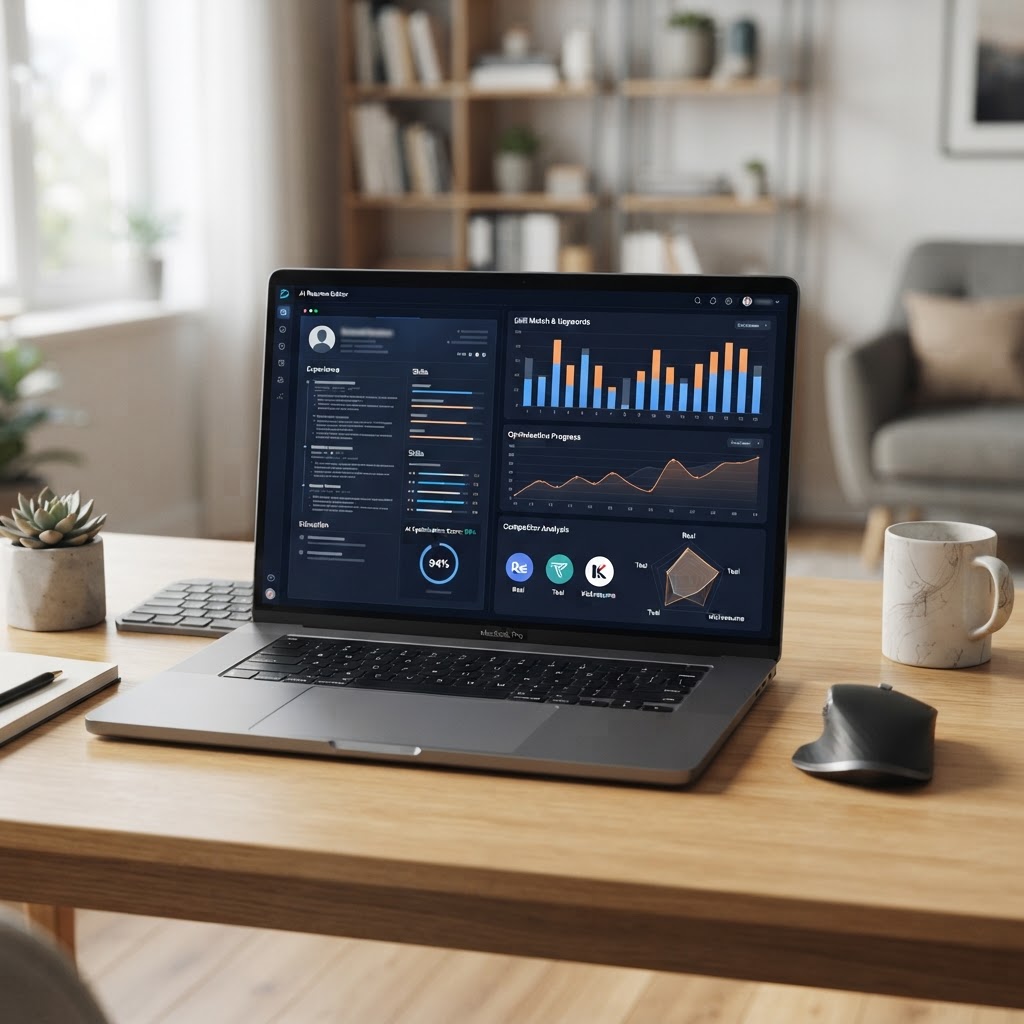
- Modern AI resume builders automate content generation and keyword mapping to significantly improve pass rates in Applicant Tracking Systems.
- ATS-friendly formatting prioritizes clean, text-based structures over complex graphics, ensuring that AI resume tools can effectively parse your professional data.
- Rezi excels in technical content optimization and rigorous ATS compliance, while Teal offers a broader suite for comprehensive career tracking.
- Kickresume stands out for its high-quality design templates, making it the preferred choice for roles requiring both professional substance and creative visual flair.
- The best AI resume builder for your needs depends on whether you prioritize automated bullet point generation, job tracker integration, or aesthetic customization.
The landscape of job hunting has undergone a seismic shift, transforming from a manual slog of document formatting and keyword guessing into a highly strategic exercise powered by machine learning. In 2026, the competitive nature of the labor market demands that candidates leverage sophisticated AI career tools to remain visible to recruiters. Choosing the best resume builder for job seekers is no longer just about picking a nice template; it is about selecting an intelligent partner capable of aligning your unique professional experience with the precise algorithmic requirements of modern hiring software. This guide examines how Rezi, Teal, and Kickresume—three industry leaders—are redefining the resume writing process by integrating advanced language models with deep industry analytics.
How AI Resume Builders Are Changing the Job Search
The traditional resume writing process was often defined by guesswork. Candidates would spend hours meticulously crafting bullet points, hoping that their chosen vocabulary would resonate with hiring managers. Today, the integration of AI resume builder technology has shifted the focus from static document creation to dynamic career optimization. These platforms act as digital career coaches, analyzing job descriptions to suggest specific professional keywords that directly correlate with the requirements set by hiring organizations.
At its core, an AI resume builder serves as a bridge between a user’s experience and an employer’s expectations. By leveraging Large Language Models (LLMs), these tools can parse a simple list of past job responsibilities and automatically transform them into results-oriented bullet points that emphasize impact, metrics, and professional growth. This process of narrative enhancement is invaluable for candidates who struggle to articulate their value proposition in a way that catches a recruiter’s eye during a six-second scan.
Furthermore, modern job application tools have moved beyond simple text generation. They now incorporate real-time guidance on resume length, white space usage, and formatting consistency—factors that are often overlooked by job seekers but prioritized by human resources software. By automating the technical aspects of layout and optimization, these tools free up the candidate to focus on the qualitative aspects of their job search, such as networking and interview preparation. Experts generally agree that this automation does not replace the human element of a job search; rather, it elevates the quality of the applications being submitted, ensuring that high-potential candidates are not filtered out of the process prematurely due to poor structure or inadequate keyword density.
The transition toward AI-driven resumes has also fundamentally changed the speed of the application process. Candidates can now iterate on their resumes for different job postings within minutes, rather than hours. This agility is a significant competitive advantage in a fast-moving market where the timing of an application often dictates whether a recruiter considers it. By creating multiple tailored versions of a resume based on specific job descriptions, users are significantly increasing their chances of passing the initial screening phases. This iterative capability is perhaps the most defining feature of current career technology, turning the resume from a static historical document into a living, breathing asset that evolves alongside the candidate’s aspirations and the changing demands of their target industry.
Understanding ATS-Friendly Formatting for AI Resumes
For any job seeker in 2026, understanding how an Applicant Tracking System (ATS) functions is as important as the professional experience listed on the document itself. An ATS acts as the primary gatekeeper for most mid-to-large sized companies. It ingests thousands of resumes and parses the text into a structured database, allowing recruiters to search for candidates based on specific skills, titles, and experiences. If your resume is not formatted in a way that the software can reliably extract data, you are essentially invisible to the company, regardless of how qualified you may be.
Resume optimization AI focuses heavily on overcoming the common pitfalls that cause ATS failures. These systems often struggle with complex designs, such as multi-column layouts, heavy graphic elements, non-standard font encoding, or information placed within text boxes and images. When a parser encounters these elements, it may return a garbled output—for example, shifting your entire work history into the contact info field, or failing to read dates of employment entirely. This is why the best resume builder for job seekers will strictly adhere to single-column, clean-text layouts.
Beyond layout, the semantic structure of an AI-generated resume is critical. An ATS looks for clear, logical headers such as “Experience,” “Education,” and “Skills.” When these sections are clearly delineated, the software can effectively categorize the data. Furthermore, these builders utilize predictive modeling to suggest formatting conventions that align with what systems are programmed to recognize as standard. This includes the use of standard bullet points over complex symbols and the avoidance of headers and footers that contain essential contact information, as the software sometimes ignores these sections entirely.
One of the most important aspects of resume writing software is its ability to map the resume’s language to the vocabulary found in job descriptions. ATS algorithms function primarily on keyword matching. If the system is looking for “project management” and the resume says “coordinated team workflows,” there is a risk of a low match score. AI tools mitigate this by scanning the job description and providing suggestions to align the user’s terminology with the specific industry jargon expected by the ATS. By balancing human-readable content with machine-parseable formatting, these platforms ensure that your resume is optimized for both the algorithm and the human who eventually reviews the output.
| Tool Name | Core Approach | Best For |
|---|---|---|
| Rezi | Strict ATS compliance and content scoring. | Technical roles and ATS-focused optimization. |
| Teal | Integrated career tracking and job management. | Long-term job hunters and career transitioners. |
| Kickresume | Design-focused AI with creative templates. | Creative, marketing, and client-facing roles. |
Rezi: The Automated Resume Optimization Powerhouse
Rezi has positioned itself as the industry standard for candidates who prioritize rigorous technical compliance above all else. Its philosophy is simple: a resume should be an engineered product designed specifically to pass automated screening. Unlike platforms that emphasize aesthetic flair or drag-and-drop design, Rezi is built upon a rigid, text-centric foundation that guarantees the highest possible compatibility with every major ATS currently in use.
The platform’s standout feature is its real-time AI content analysis. As you input your work history, the Rezi score provides immediate feedback on the “strength” of your bullet points. It checks for factors such as the presence of action verbs, the inclusion of quantifiable metrics, and, crucially, the density of industry-relevant keywords. This quantitative approach to resume editing turns the writing process into a goal-oriented task. Users are guided through a series of prompts that ensure every bullet point serves a purpose—proving competency rather than merely listing duties.
A major advantage of Rezi is its specialized integration with job descriptions. The system allows users to upload a specific job posting, which the AI then analyzes to identify the exact keywords that the recruiter is looking for. The platform then highlights your current resume content, comparing it against the desired requirements and providing specific recommendations for improvement. This feature acts as a powerful tool for resume optimization AI, as it removes the guesswork from tailoring your document. You are no longer wondering if you have included enough “project management” or “data analysis” references; the software confirms it for you.
Furthermore, Rezi offers an exceptional degree of control over the structure and flow of the resume. While some builders impose restrictive, one-size-fits-all formats, Rezi allows for granular adjustments to ensure the most relevant professional experience is highlighted at the top of the page. This is particularly beneficial for professionals with non-linear career paths or those making a pivot, as it helps in crafting a narrative that emphasizes transferable skills. Because the system is focused on machine readability, it discourages the use of design elements that typically cause parsing issues. For candidates applying to roles in finance, engineering, or legal sectors—where the ATS scan is often the most brutal hurdle—Rezi is frequently cited as the most reliable choice. Its commitment to the “content-first” methodology makes it an essential instrument for anyone serious about landing an interview in a highly competitive technical field.
Teal: The All-in-One Career Growth and Resume Suite
While Rezi focuses on the document itself, Teal takes a broader, holistic approach to the job search. Teal is better characterized as a comprehensive job application suite that includes a powerful resume builder alongside a robust job tracker and contact manager. For many job seekers, the biggest challenge isn’t just writing the resume, but staying organized throughout a multi-month search. Teal addresses this by housing every component of your search under a single, unified interface.
The Teal Resume Builder is deeply integrated with the rest of its ecosystem. For instance, the “Work Experience” section serves as a master repository of your accomplishments. From this master library, you can pull specific, pre-optimized bullet points into different resume versions for various job applications. This modularity is a massive time-saver. Rather than recreating a new document from scratch for every single role, you simply select the relevant modules from your career library and rearrange them as needed. This approach recognizes that, in a modern search, you shouldn’t just have “one” resume, but a set of components that you can mix and match to suit specific roles.
Teal’s AI is specifically tuned to aid in the “tailoring” phase of the application. It offers a side-by-side view where you can see the job description on one side and your resume on the other, with real-time feedback on your match score. It doesn’t just suggest keyword insertion; it provides insights into what skills are missing based on the job posting and gives you the option to quickly add those skills into your profile. This feedback loop is instrumental for job seekers who are applying to dozens of roles per week, as it keeps them focused on the most important aspects of the job description without getting lost in the weeds of formatting.
Beyond the builder, Teal’s job tracking dashboard is a core differentiator. It allows users to track every application status, set follow-up reminders, and even store notes about individual company contacts. In the context of a 2026 job market where networking and timely follow-ups are increasingly essential, having this data linked directly to the resumes you submitted is a game-changer. It helps you manage the psychological and logistical weight of a long-term search. Because it is a more expansive tool, Teal is ideally suited for professionals who are managing complex applications, seeking to pivot industries, or applying for high-volume roles where organizational skills are as important as the resume content itself. It is a tool designed to reduce the stress of the job search by centralizing the chaos, allowing the user to focus on the high-value activities that lead to job offers.
Kickresume: Best AI Tool for Creative and Professional Layouts
While technical compliance is non-negotiable for some industries, other sectors—such as marketing, design, communications, and public relations—place a higher value on visual communication. This is where Kickresume excels. It acknowledges that in creative fields, your resume is often the first piece of “work” a potential employer sees. If the resume is ugly or generic, it sends a signal that you lack attention to detail or design capability. Kickresume bridges the gap between high-level ATS compliance and visually engaging, modern aesthetics.
The interface of Kickresume is designed for speed and visual clarity. It provides a library of templates that are curated by design professionals, ensuring that even users with zero graphic design experience can produce a document that looks polished and professional. Crucially, even these visually oriented templates are engineered to be readable by ATS technology. The company has invested heavily in ensuring that its stylish, multi-column designs maintain their semantic structure, so your experience, skills, and education remain readable to automated scanners despite the creative layout.
The AI integration in Kickresume is particularly adept at writing. It features an “AI Writer” module that is capable of generating content based on a candidate’s job title and industry. For those who find the “blank page” syndrome difficult to overcome, this tool is invaluable. It can draft entire cover letters, professional summaries, and detailed work experience sections in seconds. Unlike some generic AI tools, Kickresume’s AI is specifically tuned to follow professional resume conventions, making it easier to achieve a professional tone without needing extensive editing.
Another standout feature is the platform’s support for modern resume formats, including websites and interactive links. Many creative roles now encourage candidates to provide a link to a digital portfolio or an interactive resume, and Kickresume allows users to convert their written document into a web-based format effortlessly. This is a significant advantage for candidates who want to showcase their personality or their ability to work with modern web tools. For professionals who operate in environments where standing out visually is just as important as the content itself, Kickresume provides the perfect balance. It ensures that the document is not only technically sound and optimized for keyword discovery but also aesthetically superior to the standard, dull resumes that many other candidates will be submitting. It effectively gives you the tools to treat your resume like a marketing piece while still keeping the underlying data structured for the software gatekeepers.
Comparing Pricing Models: Free vs Premium AI Features
When selecting the best resume builder for job seekers in 2026, understanding the distinction between freemium access and premium subscriptions is critical. Most platforms in this space operate on a tiered model designed to lower the barrier to entry while reserving high-powered AI capabilities for paying subscribers. As you evaluate Rezi, Teal, and Kickresume, you will notice that the “free” offerings typically serve as a proof-of-concept rather than a full-service career management suite.
Typically, a free account allows users to create a single resume using basic templates and simple text editors. While these tools often include standard ATS-friendly formatting, they frequently omit the advanced AI optimization features that distinguish modern resume writing software. For instance, free versions may limit the number of AI-driven bullet point refinements, restrict access to high-end design templates, or impose caps on how many times you can tailor your resume to specific job descriptions. In contrast, premium tiers often unlock unlimited AI generation, real-time feedback on keyword density, and direct integrations with job boards or LinkedIn.
A major differentiator in 2026 is the inclusion of “career strategy” tools. Premium subscribers often gain access to mock interview prep, automated cover letter generators, and advanced career tracking dashboards that manage multiple applications simultaneously. Before committing to a subscription, it is essential to determine if you are paying for aesthetic design choices or substantive content-optimization features. Many users find that the subscription cost is justified if the platform reduces the time spent on manual keyword optimization—a task that can consume hours for every application.
| Tool | Free Tier Offering | Premium AI Focus | Best For |
|---|---|---|---|
| Rezi | Single resume, basic ATS formatting. | GPT-4 powered content generation and keyword targeting. | Tech-heavy roles requiring precise ATS formatting. |
| Teal | Resume builder with limited tracking. | Extensive job matching and skills-gap analysis. | Candidates managing a high volume of job applications. |
| Kickresume | Basic document creation, limited templates. | Advanced design aesthetics and AI cover letter writing. | Creative professionals needing polished designs. |
Common Mistakes to Avoid When Using AI Resume Writers
While AI career tools have revolutionized the job application process, over-reliance on automation can lead to generic, robotic, or inaccurate resumes. The most common pitfall for job seekers is failing to perform a human audit of AI-generated content. AI models are trained on vast datasets, but they can sometimes hallucinate roles, responsibilities, or technological proficiencies that you do not actually possess. Always verify every line of text generated by an AI against your own professional history.
Another frequent mistake is “keyword stuffing.” While resume optimization AI is designed to help you rank higher in Applicant Tracking Systems, over-optimizing by cramming as many industry buzzwords as possible into your resume can degrade the readability for human recruiters. Modern ATS software is increasingly sophisticated and can detect unnatural phrasing. Your goal should be to integrate high-value keywords naturally into context-rich achievement statements, rather than creating a block of invisible text or a list of buzzwords that lacks narrative flow.
Many users also fail to personalize the AI’s output to the specific organizational culture of their target employer. If you simply accept the AI’s default phrasing for every job, you risk creating a document that sounds identical to thousands of other applicants. Furthermore, ignoring the importance of professional metrics—such as percentages, currency values, or specific team sizes—is a major error. AI often generates strong action verbs but may fail to include the quantitative data that hiring managers use to measure impact. You must manually inject your own unique performance metrics to make your resume truly stand out.
How to Customize AI-Generated Content for Your Target Role
To maximize the effectiveness of your resume, you must bridge the gap between AI-provided templates and your actual professional narrative. The customization process begins by importing the specific job description into the AI tool. This allows the software to perform a “skills gap analysis,” identifying the specific technical and soft skills the employer is seeking. However, do not stop there; use this analysis as a roadmap to prioritize which of your accomplishments to highlight.
A highly effective strategy is to map your professional experiences to the requirements listed in the job post. If an employer emphasizes cross-functional leadership, ensure your top three bullet points reflect a time you led a team or coordinated across departments. AI is excellent at drafting the phrasing, but it cannot know which specific stories from your career best demonstrate those traits. Use the “AI rewrite” feature to take your rough, anecdotal descriptions and convert them into punchy, outcome-oriented statements that match the tone of the job description.
Finally, utilize the “skills section” customization. Many AI tools will suggest a generic list of skills based on your job title. You must manually curate this list to include only those skills you can defend in an interview. Delete any AI-suggested skills that are irrelevant to the specific role or that you do not feel confident discussing. Remember that the AI is your assistant, not your author; the final document should be a reflection of your intent and your unique career journey.
Privacy and Security: Protecting Your Data in Resume Tools
When using AI resume builders, you are essentially feeding proprietary information into large language models and cloud-based databases. It is essential to be aware of how these platforms handle your personal data. Before signing up for an AI career tool, review the service’s privacy policy, specifically looking for clauses regarding data retention and model training. Some companies may use your uploaded resume data to retrain their algorithms unless you explicitly opt out.
To maintain your professional security, always scrub your resume of highly sensitive personal identification numbers or addresses before uploading it to a cloud-based resume builder. If you are currently employed, be cautious about using an employer-provided email address to create your account. If the platform experiences a data breach, you do not want your personal career documentation associated with your current company’s digital footprint.
Furthermore, understand the difference between local storage and cloud syncing. If you are dealing with sensitive intellectual property from your previous roles, consider whether the resume builder offers a way to delete your data permanently after your job search is complete. Most reputable tools will offer a “delete account” feature that purges your profile, but it is wise to confirm this in their documentation. By taking a proactive approach to data hygiene, you can leverage the power of AI while minimizing the risk to your personal and professional confidentiality.
Frequently Asked Questions
Are AI-generated resumes actually better at passing ATS scanners?
Generally, yes. AI tools are built specifically to understand the logic of Applicant Tracking Systems. By using standardized headings, removing non-parsable graphics, and integrating keywords found in job descriptions, these tools ensure that your resume is structurally sound and formatted in a way that modern software can easily ingest and rank.
Do recruiters know if I used an AI resume builder?
Recruiters are becoming increasingly adept at spotting “AI-speak,” which is characterized by overly flowery language or repetitive phrasing. However, if you use these tools as a drafting aid and spend time refining the content to match your unique professional voice, it is unlikely a recruiter will be able to distinguish your work from a manually written document.
Is it worth paying for a premium AI resume subscription?
For most job seekers, a premium subscription is worth the investment if you are applying to multiple high-competition roles simultaneously. The time saved in formatting and keyword optimization—combined with the value of extra features like cover letter generation and interview preparation—typically offsets the monthly subscription cost.
Can AI resume builders handle career transitions effectively?
AI tools can be quite effective for career pivots because they can help reframe your existing skills in a new context. By providing the AI with the skills you possess and the target job description, it can highlight transferable experiences that a human writer might overlook, bridging the narrative gap between your past and future roles.
What should I do if the AI suggests a skill I don’t have?
You should immediately remove it. Never include a skill on your resume that you cannot verify or demonstrate during an interview. While the AI may suggest the skill because it is a common requirement in the industry, including it falsely will lead to significant embarrassment and potential disqualification during the technical assessment phase of the hiring process.
Do I still need to write a cover letter if my resume is AI-optimized?
Yes. Even with a perfectly optimized resume, a cover letter provides the narrative context for why you are interested in the specific company. Many AI tools now offer integrated cover letter generators that pull context from your resume and the job description, making it much faster to produce a personalized, compelling argument for your candidacy.
Conclusion
As we navigate the job market of 2026, the reliance on advanced AI tools is no longer an optional shortcut—it is a competitive necessity. Whether you choose the technical precision of Rezi, the comprehensive tracking capabilities of Teal, or the aesthetic flexibility of Kickresume, these platforms offer the leverage needed to navigate the complexities of modern hiring. However, the true “secret sauce” of a successful application remains your ability to balance AI efficiency with human authenticity. By treating these tools as partners rather than sole authors, you can ensure your resume is not only optimized for the algorithm but also deeply compelling to the human recruiter reading it. Start by evaluating your specific needs, audit your content for accuracy, and maintain a proactive stance on your data privacy. The best AI resume builder is one that empowers your unique professional story to reach the desk of the right hiring manager. Take the next step in your career journey by selecting the tool that aligns with your professional goals today.
By aismarttoolsreview Editorial Team
Leave a Reply