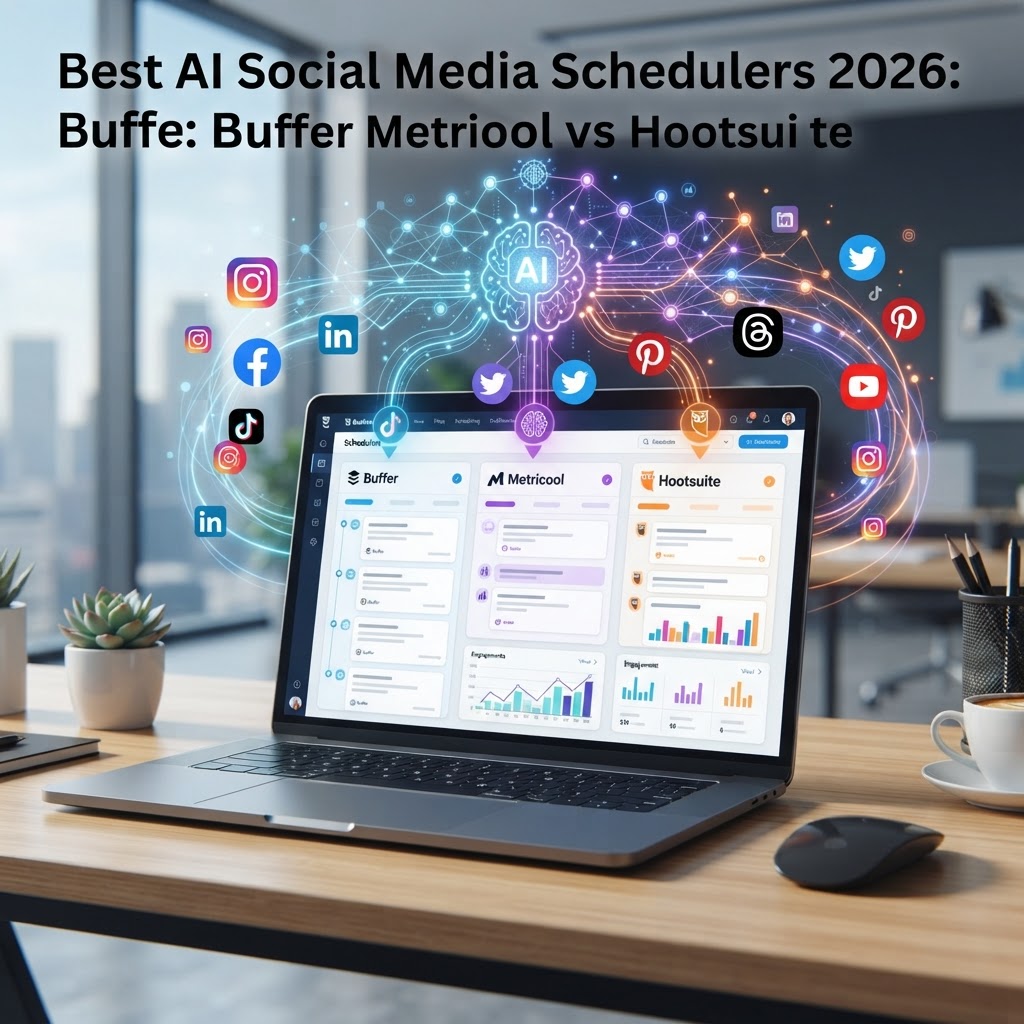
- AI social media schedulers in 2026 have moved beyond simple auto-posting to predictive content performance modeling.
- Optimal posting times are now calculated by cross-referencing global platform activity with niche-specific audience engagement patterns.
- Buffer offers a streamlined, user-friendly approach ideal for solopreneurs and small creative agencies focusing on brand aesthetic.
- Metricool provides superior analytical depth, making it the preferred choice for data-heavy marketers who prioritize granular reporting.
- Hootsuite remains the industry standard for large-scale enterprise teams requiring complex governance, AI-driven compliance, and cross-departmental workflows.
As we navigate the sophisticated digital landscape of 2026, the demand for agility in content distribution has reached a fever pitch. Marketers are no longer merely competing for attention; they are competing against highly optimized algorithmic feeds that favor hyper-relevant, timely, and consistent output. The emergence of the AI social media scheduler has transformed what was once a laborious manual task—copying, pasting, and scheduling posts—into a streamlined, intelligent pipeline. Whether you are a small business owner aiming for visibility or an enterprise manager overseeing global brand sentiment, selecting the right automated social media tool is now the primary determinant of your digital ROI. In this comprehensive review, the aismarttoolsreview Editorial Team analyzes the three industry titans: Buffer, Metricool, and Hootsuite, to help you determine which software aligns with your strategic goals for the remainder of 2026 and beyond.
Why AI Social Media Scheduling is Essential in 2026
In the current social media ecosystem, the velocity of content consumption has accelerated to the point where human manual intervention is often insufficient for maintaining peak visibility. The best social media management software 2026 now incorporates advanced machine learning models that treat the content calendar as a dynamic, living organism rather than a static spreadsheet. Why is this transition essential? First, the sheer fragmentation of audience attention across diverse platforms—TikTok, Instagram, LinkedIn, and nascent decentralized social networks—means that creating “one size fits all” content is a strategy destined for failure.
AI-powered schedulers allow teams to practice “content atomization.” By using generative AI, these tools can automatically repurpose a long-form video or white paper into multiple micro-posts tailored for the specific technical constraints and audience expectations of individual platforms. This ensures that a brand maintains a consistent presence without burning out the human creative team. Furthermore, social media scheduling with AI provides a crucial buffer against algorithmic volatility. Platforms frequently update their feed prioritization logic, and AI tools are generally quicker to detect these shifts through large-scale behavioral data analysis.
Moreover, as we move through 2026, the focus has shifted toward “predictive engagement.” Rather than looking at past performance in isolation, AI tools now cross-reference historical post success with external variables such as industry news cycles, seasonal shifts, and even real-time global trending topics. By leveraging these AI content calendar tools, brands can proactively schedule high-impact posts when their specific target demographics are most likely to be in a “purchasing” or “discovery” mindset. This shift from reactive scheduling to proactive strategy is the hallmark of modern digital marketing. When teams choose to integrate an automated social media tool into their stack, they are essentially outsourcing the monotonous logistical labor to algorithms, which frees up human creative resources to focus on high-level narrative strategy and brand voice—elements that, even in 2026, require the nuance and empathy of a human mind. Consequently, the businesses that thrive this year will be those that view their AI scheduler not as a simple utility, but as a strategic partner that dictates the cadence and quality of their entire digital footprint.
How AI Algorithms Optimize Posting Times for Higher Reach
The concept of the “perfect posting time” has evolved significantly. In the early days of social media management, posting times were determined by global averages—a broad assumption that users were active during lunch hours or early evenings. Today, AI-driven scheduling tools utilize individual, proprietary models that create a unique temporal signature for every brand account. The mechanism behind this is rooted in pattern recognition. An AI social media scheduler continually ingests data from incoming interactions: likes, shares, comments, and saves, tagged with precise timestamps.
These tools build a high-fidelity probability map for your audience. For instance, an AI might detect that your specific followers engage at higher rates with educational carousel content on Tuesday mornings, while their appetite for short-form entertainment videos spikes on Friday evenings. This level of granularity is achieved through multi-variate analysis. The AI doesn’t just look at when the user is “active” on the app; it analyzes the context of the engagement. If a user habitually views your content during their commute, the algorithm learns to prioritize your delivery at 8:00 AM local time.
Furthermore, these tools often incorporate “smart queues” that automatically adjust to shifts in audience behavior. If your brand gains a significant following in a different time zone, the AI detects the migration in engagement patterns and gradually shifts your posting windows to align with the new demographic reality. This “continuous learning” aspect is critical. If your reach begins to decline, the AI doesn’t simply continue the old schedule; it initiates a testing phase, rotating different slots to see if user habits have shifted due to platform-wide changes or external lifestyle factors.
Beyond simple time-slot calculation, these algorithms perform “congestion avoidance.” Many AI tools are now capable of analyzing posting frequency to ensure you are not saturating the feed to the point of algorithmic penalty, nor are you posting so sparingly that you lose “recency” value in the feed. By striking this delicate balance, automated social media tools ensure your content is delivered when it has the highest statistical probability of triggering early engagement—a metric that algorithms use to determine whether to push your post to a wider audience. This creates a virtuous cycle of visibility that is almost impossible to replicate manually, confirming that the best social media management software 2026 relies heavily on the marriage of predictive temporal logic and real-time responsiveness.
| Tool | Core AI Focus | Best For |
|---|---|---|
| Buffer | Generative Content & User Interface | Solopreneurs & Small Agencies |
| Metricool | Data Analytics & Predictive Reach | Data-Driven Marketers & Influencers |
| Hootsuite | Enterprise Governance & Cross-Channel Flow | Large Organizations & Multi-Team Units |
Buffer: Leveraging AI for Simplified Social Automation
Buffer has long been regarded as the gold standard for intuitive, user-centric design, and its integration of AI tools for 2026 cements this reputation for smaller teams and individual creators. While other enterprise-grade tools may overwhelm the user with dense dashboards, Buffer uses AI to reduce cognitive load. The primary focus of Buffer’s AI integration is the “Assistant” feature, which serves as a generative powerhouse for the content creation process. Instead of forcing users to struggle with creative blocks, Buffer allows creators to input a basic concept and generate multiple caption variations, tone adjustments, and even relevant hashtag sets that are tuned for the specific platform of choice.
This simplified approach makes Buffer an excellent AI social media scheduler for those who prioritize efficiency. The workflow is designed to be linear and friction-free: you draft, you use the AI assistant to polish the copy, and you slot it into the “Smart Queue.” This queueing system is the backbone of Buffer’s automation. It takes the guesswork out of timing by automatically suggesting the best slots based on your historical account data. For a user managing three or four social channels, the complexity of manual scheduling is effectively eliminated. The AI recognizes when you have hit a “dry spell” in your content calendar and will proactively prompt you with content ideas based on the links you’ve recently shared or common industry themes.
What sets Buffer apart in 2026 is its commitment to “aesthetics-first” planning. The visual grid planner, augmented by AI, helps users visualize their Instagram or TikTok feed layout to ensure color palettes and themes are consistent across posts. It is a tool designed for the modern creator who values brand identity as much as, if not more than, raw metrics. While it may not offer the deep, complex analytical reporting found in tools like Hootsuite, it excels at providing exactly what a small business needs: a clean, automated, and AI-assisted path to consistency. By automating the mundane—such as re-sizing images for different platforms or recycling “evergreen” content—Buffer ensures that the creator remains the visionary, while the software handles the mechanics of presence. It is a balanced approach that proves you do not need enterprise-level complexity to achieve high-performance results.
Metricool: Data-Driven Scheduling with Advanced AI Insights
For those who view social media marketing as a strictly quantitative discipline, Metricool has emerged as a premier contender in 2026. This platform is built for the “analyst-marketer,” someone who prefers to make decisions based on empirical evidence rather than intuition. Metricool’s AI-powered scheduler stands out primarily because of its deep integration with its industry-leading analytics suite. Unlike basic scheduling tools that treat posting times as a suggestion, Metricool treats them as a data-proven mandate.
The platform provides a heatmap of your audience’s activity that is updated in real-time, leveraging AI to forecast when your specific followers will be most receptive. If your audience begins to shift their habits—say, moving from late-night browsing to early-morning checking—Metricool updates its “best times to post” suggestions dynamically. This makes it an incredibly powerful automated social media tool for influencers and performance marketers who need to squeeze every drop of engagement out of their content. Furthermore, Metricool’s AI tools extend to competitor analysis. By inputting the handles of industry rivals, the platform’s AI evaluates their posting frequency, content styles, and audience growth rates, providing actionable benchmarks. This allows you to fill gaps in your own content calendar that competitors have left wide open.
Perhaps the most impressive feature for the current year is the “AI Summary” function. Navigating complex reports can be time-consuming; Metricool uses generative AI to distill thousands of data points into simple, plain-English summaries. Instead of pouring over charts to understand why your engagement dropped last Tuesday, you can ask the Metricool AI to identify the core drivers of that performance dip. It might point to a change in the platform’s algorithm, a decrease in posting frequency, or a misalignment in content topics. This feedback loop is essential for refining one’s strategy on the fly. Metricool isn’t just about scheduling; it’s about learning. By providing users with granular insights alongside an efficient scheduling interface, it bridges the gap between raw data and creative strategy. For agencies or solo marketers handling dozens of accounts, the ability to generate reports automatically—while ensuring those reports contain meaningful, AI-derived insights—is a massive value proposition. It makes the entire management process transparent, measurable, and highly optimized, ensuring that every post is backed by a sound, data-driven hypothesis.
Hootsuite: Enterprise-Grade AI Scheduling and Workflow Management
Hootsuite remains the heavy hitter in the world of social media management, specifically catering to the needs of large organizations, global brands, and multi-departmental teams. In 2026, Hootsuite’s AI capabilities have matured into a comprehensive governance and workflow engine. Where Buffer focuses on individual simplicity and Metricool on individual performance, Hootsuite focuses on scale, safety, and sophisticated orchestration.
The central component of Hootsuite’s AI strategy is “OwlyWriter AI.” This isn’t just a caption generator; it is a full-fledged content lifecycle manager. For enterprise teams, the challenge isn’t just writing a post—it is ensuring that the post complies with brand guidelines, legal regulations, and cross-departmental approval processes. Hootsuite’s AI is integrated directly into these governance workflows. When a user creates content, the AI can scan for brand-inappropriate language, verify that the tone of voice matches the corporate style guide, and even suggest appropriate hashtags based on the internal company taxonomy. This level of oversight is mandatory for teams handling high-stakes accounts where a single errant post could cause significant reputational damage.
Furthermore, Hootsuite’s AI excels in its “Social Listening” capabilities. By monitoring millions of social mentions across the web, the AI filters out the noise and alerts managers to significant shifts in brand sentiment or potential PR crises before they escalate. This real-time intelligence is then fed back into the scheduling workflow. If the AI detects a global trending topic relevant to your industry, it can suggest a pivot in your scheduled content to stay current, or provide data-backed inspiration for new, reactive posts.
The scheduling interface itself is built to handle thousands of posts across hundreds of accounts simultaneously, using AI to detect potential conflicts or scheduling overlaps between departments. This creates a unified “source of truth” for the organization. While the learning curve is steeper than its competitors, the payoff for enterprises is clear: reduced risk, standardized creative quality at scale, and a deep, multi-layered understanding of how social media activity translates into corporate objectives. In an era where large-scale digital coordination is difficult, Hootsuite’s focus on enterprise-grade AI makes it the undisputed leader for organizations that view social media as a core business function rather than an auxiliary task. The AI isn’t just helping to write the post; it is helping to protect the brand, manage the team, and align the entire social footprint with global business KPIs.
Predictive Content Creation: How AI Suggests Trending Topics
In the landscape of 2026, the best social media management software is no longer a passive repository for pre-written posts. Instead, it functions as a strategic partner capable of predictive content creation. By leveraging machine learning models trained on vast datasets of viral trends, hashtags, and industry-specific news cycles, modern tools like Buffer, Metricool, and Hootsuite now offer “trend forecasting” features that identify high-potential topics before they saturate the market.
The mechanism behind these predictive engines involves real-time scraping and sentiment analysis. When an AI social media scheduler monitors your niche, it scans for spikes in query volume, engagement metrics on influencer accounts, and shifts in audience discourse. For instance, if you manage a fitness brand, the AI might detect a nascent interest in a specific wellness trend—perhaps a niche recovery technology—and prompt you to draft content about it while the topic is still in its growth phase, rather than its saturation phase. This capability effectively transitions social media teams from a reactive posture to a proactive one, ensuring that your automated social media tool aligns your content calendar with the actual pulse of the internet.
Furthermore, these tools provide “content intelligence” by analyzing the historical success of your own feed. By comparing your top-performing posts against trending topics, the AI identifies unique content gaps. If data suggests your audience is highly engaged with long-form video explainers but currently underserved in the realm of industry news analysis, the scheduler will highlight this opportunity, suggesting topics that bridge the gap between your brand identity and current viral events. This creates a data-backed foundation for every item on your content calendar, significantly reducing the guesswork associated with creative planning.
Automated Caption Writing and Hashtag Generation Tools
The bottleneck of social media management often lies in the “copywriting phase.” Generating high-converting captions while maintaining a consistent brand voice across platforms is a time-intensive endeavor. AI-powered caption generators now utilize Large Language Models (LLMs) tuned specifically for the nuances of short-form copy. These tools do not merely provide generic text; they ingest your previous posts to learn your specific tone—whether professional, irreverent, authoritative, or playful—and apply it to new content requests.
Modern captioning tools go beyond simple text generation; they integrate visual context. For example, when you upload an image to an automated social media tool, the AI analyzes the visual assets—detecting the subject matter, the color palette, and the overall mood—to generate context-aware captions. If the image depicts a team meeting, the AI may suggest a caption focused on office culture, whereas the same image in a different context might prompt a request for a professional milestone announcement. This level of semantic understanding is what separates top-tier AI content calendar tools from basic automation scripts.
Hashtag generation has also evolved from simple tag-cloud builders to sophisticated reach optimization engines. Instead of suggesting the most popular hashtags (which are often too crowded to provide meaningful reach), AI schedulers now prioritize “community-specific” hashtags. These are medium-volume tags with high intent, which are statistically more likely to place your content in front of interested users rather than bots. By continuously monitoring which hashtags actually drive profile visits and link clicks, these tools suggest a rotating, optimized set of tags for every post, ensuring that your visibility efforts are always backed by recent performance data.
Cross-Platform Syncing: Managing Multi-Channel Feeds Effortlessly
Multi-channel management remains one of the primary pain points for digital marketers. A post that performs optimally on LinkedIn often requires significant reframing to garner traction on Instagram or TikTok. Automated social media tools now mitigate this through “content adaptation engines.” Rather than simply duplicating a post across all channels—a strategy that often lowers engagement due to a lack of platform-specific formatting—these tools offer one-click transformations that resize visuals, adjust text length, and even rewrite call-to-action buttons to suit the cultural norms of each destination channel.
The integration of cross-platform syncing means that when you schedule a post via an AI scheduler, the software manages the intricacies of platform-specific requirements: character limits for posts, optimal aspect ratios for imagery, and even specific times when your audience on each platform is most likely to be online. This centralized control ensures that your content calendar remains cohesive; you can see a “master view” of your brand’s presence across all channels simultaneously. This visibility is crucial for detecting redundant posting schedules, where an audience member might see the same content multiple times across different apps within a short window, leading to potential “brand fatigue.”
Furthermore, cross-platform syncing allows for shared asset libraries that stay updated across all connected accounts. If you update a brand logo or a standard disclaimer in your main asset library, the AI scheduler can flag or automatically update any posts in your future queue that utilize those specific assets. This level of synchronization is essential for large teams or agencies where consistency across dozens of accounts is the primary metric for operational success.
| Tool | Primary AI Focus | Best For |
|---|---|---|
| Buffer | Simplicity and Workflow Optimization | Small businesses and solopreneurs |
| Metricool | Data Analytics and Multi-Platform Intelligence | Data-driven marketing teams and agencies |
| Hootsuite | Comprehensive Enterprise Management | Large organizations and high-volume brands |
Comparing Pricing Models for AI-Enhanced Scheduling Tools
The pricing structures for AI social media schedulers in 2026 vary significantly based on the depth of AI functionality included. Generally, platforms follow a tiered “freemium” or “pro-tier” model, where basic scheduling is affordable, but advanced AI predictive capabilities are locked behind premium subscriptions. It is essential to distinguish between “template-based” automation and true “AI intelligence.”
Many entry-level tiers provide access to simple caption generation or basic automated posting times, which are useful for startups. However, for brands seeking to scale, the value lies in the “Advanced Analytics” tiers. These tiers typically include the predictive content forecasting mentioned earlier and more sophisticated social listening tools. While these tiers represent a higher monthly commitment, they often pay for themselves by drastically reducing the man-hours required for social media research, copywriting, and performance reporting. When evaluating the cost of these tools, consider the total cost of ownership, including the time saved by your social media team, rather than just the raw subscription fee.
Choosing the Best AI Scheduler for Your Brand Growth Goals
Selecting the best social media management software 2026 comes down to aligning the software’s strengths with your specific growth strategy. If your primary goal is rapid expansion through high-volume, trend-based content, you should prioritize a scheduler that excels in predictive forecasting and trend analysis, such as tools that offer robust social listening. If your goal is brand consistency and professional, curated content, look for platforms that emphasize deep AI copywriting integration and advanced cross-platform asset management.
Consider the learning curve of the software as well. A feature-rich enterprise tool might provide extensive AI control, but if it takes your team weeks to master, you may lose the agility you sought to gain. Always look for tools that offer a trial period where you can run a “test week” of scheduling. During this trial, track how many hours the AI-suggested topics and captions saved you compared to your traditional manual workflow. Growth is a product of speed and precision; choose the tool that enables your team to move faster while maintaining the highest quality of output.
Frequently Asked Questions
How does an AI social media scheduler differ from a standard scheduling tool?
A standard scheduler simply executes commands at pre-set times. An AI social media scheduler uses data analysis, machine learning, and natural language processing to assist in the content creation process itself, offering topic suggestions, caption drafting, and intelligent timing adjustments based on historical performance.
Can AI schedulers really match my brand voice?
Modern AI schedulers are highly adaptable. By utilizing “brand voice profiles” and analyzing your past successful content, these tools can learn your vocabulary, tone, and formatting preferences, significantly reducing the amount of human editing required to maintain consistency.
Do these AI tools replace the need for a social media manager?
No. AI is designed to augment human strategy, not replace it. While AI excels at repetitive tasks like hashtag research and caption drafting, humans remain essential for high-level creative direction, crisis management, authentic community engagement, and strategic brand positioning.
Will using an AI scheduler hurt my social media reach?
On the contrary, when used correctly, AI can enhance reach. By using AI to identify trending topics and optimal posting times—factors that are often impossible to track manually at scale—you can increase the likelihood of your content being surfaced by platform algorithms to interested users.
Is my brand data secure when using these AI-powered tools?
Reputable social media management software platforms invest heavily in enterprise-grade security. They generally comply with strict data privacy regulations, ensuring your internal content and customer data are encrypted. However, it is always recommended to review the privacy policy of any tool you integrate into your workflow.
How do I know which AI tool is right for my team size?
Small teams often benefit from intuitive, all-in-one platforms with lower entry costs. Larger teams or agencies should look for tools that offer robust user permissions, team collaboration workflows, and consolidated multi-account analytics to ensure operational efficiency at scale.
Conclusion
As we move deeper into 2026, the adoption of AI-powered social media tools is no longer a competitive advantage—it is a baseline requirement for sustainable growth. Whether you choose the agile, user-friendly environment of Buffer, the data-rich insights of Metricool, or the enterprise-grade power of Hootsuite, the goal remains the same: to minimize administrative friction and maximize human creativity.
By delegating time-consuming tasks like trend forecasting, caption writing, and cross-platform formatting to intelligent algorithms, you free your team to focus on the truly vital aspects of social media: building genuine community and crafting compelling brand narratives. Now is the time to evaluate your current workflow, identify the bottlenecks hindering your growth, and implement an AI-enhanced scheduling solution that serves your long-term objectives. Start by requesting a demo or initiating a trial period with one of these leading tools to see how much of your workday you can reclaim today.
By aismarttoolsreview Editorial Team
Leave a Reply