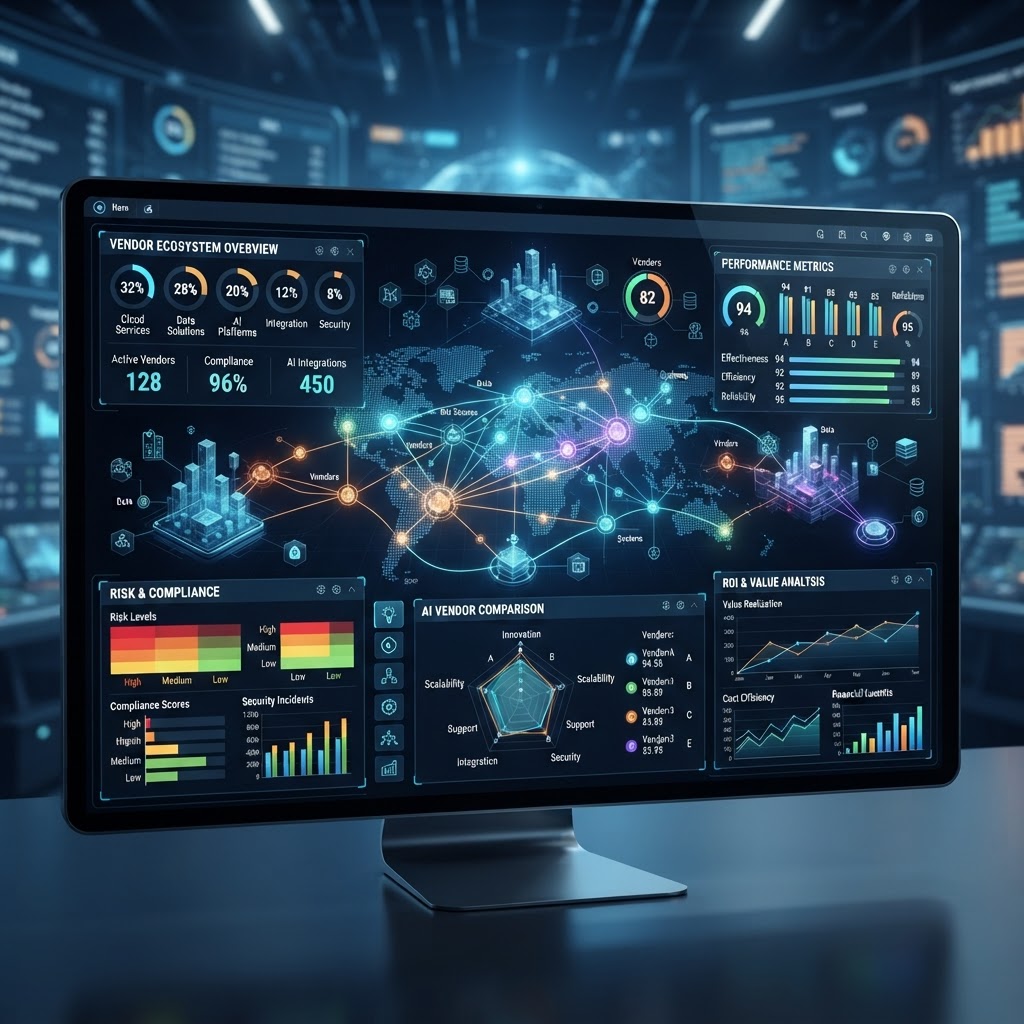
- AI-driven platforms are transforming procurement by shifting focus from manual data entry to strategic supplier relationship management.
- Automated vendor onboarding reduces cycle times by identifying bottlenecks and enforcing compliance standards in real-time.
- Machine learning algorithms excel at predictive vendor risk assessment, alerting procurement teams to financial or operational instability before it disrupts the supply chain.
- Selecting the right software requires balancing specialized AI functionality against existing ERP and CRM integration capabilities.
- By 2026, high-performing procurement teams will treat AI supply chain tools as essential infrastructure for scaling global operations.
As the global supply chain becomes increasingly volatile, the traditional, manual approach to procurement is proving insufficient for the modern enterprise. By 2026, the competitive edge in business operations will belong to organizations that effectively leverage intelligent automation to streamline their procurement lifecycle. Managing a vast network of suppliers is no longer just about tracking invoices and contracts; it is about maintaining a real-time, data-driven view of risk, compliance, and performance. AI vendor management has emerged as the definitive solution for teams struggling to keep pace with complex vendor ecosystems. In this comprehensive guide, the aismarttoolsreview Editorial Team analyzes the evolution of vendor management software and provides an objective look at how the latest AI-integrated tools can transform your procurement function from a cost center into a strategic engine of growth.
Why Businesses Need AI in Vendor Management
The complexity of modern supply chains has outpaced the capability of legacy procurement systems. Traditionally, vendor management relied on disconnected spreadsheets, manual email threads, and disparate software modules that rarely communicated effectively. In an era of rapid global digital transformation, this manual overhead often leads to fragmented data, missed compliance deadlines, and a lack of visibility into actual supplier performance. Businesses are increasingly turning to AI vendor management to bridge these gaps, shifting their internal resources from administrative firefighting to high-value strategic decision-making.
AI introduces a layer of cognitive processing to procurement that standard automation cannot match. While traditional software is excellent at executing pre-defined rules, AI-enhanced systems can ingest massive quantities of unstructured data—such as market trends, geopolitical shifts, news reports, and financial filings—to provide actionable insights. For example, when a global logistics disruption occurs, an AI-powered system doesn’t just notify a manager that a shipment is late; it analyzes the ripple effect across the entire supply chain, suggests alternative suppliers from a pre-vetted database, and simulates the cost impact of switching. This predictive capability is essential for businesses operating in 2026, where the speed of adaptation defines market survival.
Furthermore, AI tools help eliminate the “silo effect” that plagues large organizations. Often, the legal department, the procurement team, and the finance office operate on different systems, leading to redundant vendor assessments and conflicting vendor status updates. AI-driven platforms act as a single source of truth, synthesizing information across departmental lines. This transparency ensures that every stakeholder is looking at the same vendor risk scores and compliance certifications. When an AI tool flags a vendor for a potential regulatory issue, it can automatically trigger alerts for the appropriate departments, ensuring that legal reviews and financial audits are synchronized. By centralizing this data, organizations reduce the administrative burden of cross-functional communication, minimize the risk of human error, and create a scalable architecture that grows alongside the business. Ultimately, the transition to AI in vendor management is less about replacing human judgement and more about augmenting it with the speed, precision, and broad-spectrum analytical power required to navigate the complexities of the mid-2020s landscape.
Key Features to Look for in Vendor Software
Selecting the right platform requires a deep understanding of what technical capabilities drive real value. While “AI-powered” is a common marketing claim, the actual utility of these tools depends on their architectural design and integration ecosystem. When evaluating vendor management software for 2026, procurement leads should prioritize systems that offer specific functionalities capable of turning raw data into strategic advantage.
A core feature to prioritize is advanced natural language processing (NLP) for document processing. Vendors interact with your organization via a mountain of paperwork: invoices, certificates of insurance, ESG reports, and master service agreements. An effective AI tool should be able to scan, extract, and categorize data from these documents automatically, cross-referencing them against your compliance requirements without manual intervention. Beyond basic OCR (Optical Character Recognition), look for “context-aware” extraction that understands legal clauses, payment terms, and vendor diversity status.
Integration capability is perhaps the most important technical hurdle. An AI tool that exists in a vacuum is virtually useless. Ensure the software offers robust APIs or native connectors for your existing ERP (Enterprise Resource Planning), CRM, and accounting systems. Data silos are the primary enemy of efficient procurement, and the software you choose must be able to pull and push data seamlessly to avoid dual-entry workflows. Below is a comparison of different approaches to modern procurement software architectures:
| Approach | Primary Benefit | Best For |
|---|---|---|
| All-in-One Suites | Unified interface and data model | Enterprises seeking end-to-end integration |
| AI-Layer Add-ons | Specialized predictive analytics | Teams with stable legacy ERP systems |
| Modular SaaS Platforms | High flexibility and rapid deployment | Agile, growth-stage organizations |
| Custom AI Frameworks | Tailored alignment with niche workflows | Highly regulated industries with complex needs |
Finally, look for proactive AI-driven benchmarking. The best tools don’t just track your vendors; they compare them against market averages. Does this vendor’s pricing align with current market trends? Is their delivery time slower than industry peers? Benchmarking features leverage aggregated, anonymized data to give your procurement team an objective basis for contract negotiations. When combined with predictive risk modeling, these features transform the software from a simple filing cabinet into an active advisor that guides your sourcing strategy toward higher margins and lower risks.
How AI Enhances Vendor Onboarding Efficiency
The onboarding process is often the most significant bottleneck in the procurement lifecycle. Collecting tax forms, verifying identity, checking compliance certifications, and setting up payment systems typically involves a back-and-forth exchange that can take weeks, if not months. AI vendor management systems revolutionize this experience by shifting the burden from manual administrative oversight to intelligent automation, creating a self-service, friction-less path for new partners.
Automate vendor onboarding is not merely about digitizing a PDF form; it is about creating a “smart pipeline” that adapts to the vendor’s profile. An AI-enhanced system will analyze the initial vendor data entered by the potential supplier and automatically adjust the subsequent requirements. For instance, if a supplier is based in a high-risk jurisdiction, the AI will immediately initiate a specific set of extra due diligence questions and regulatory checks that are irrelevant for a local, low-risk office supply vendor. This conditional logic saves significant time by ensuring that neither the procurement team nor the supplier is bogged down by unnecessary paperwork.
Furthermore, AI provides real-time validation. As vendors upload required documentation, machine learning models verify the files instantly—checking for expiration dates, correct formatting, and valid identification numbers. If a document is incomplete or contains a potential error, the system provides immediate, automated feedback to the supplier, eliminating the wait time that usually occurs when a human reviewer discovers a mistake days later. This cycle continues until the profile reaches a state of “ready-for-review,” allowing procurement officers to focus solely on high-level approval rather than document collection.
Beyond speed, AI improves the quality of onboarding data. Manual input is prone to errors, such as typos in banking details or missed entries in compliance fields. AI tools standardize data entry by pulling information directly from external business registries and verified financial databases, ensuring that the vendor record is accurate from the very first interaction. This accuracy reduces the downstream risk of payment failures or compliance breaches later in the relationship. By implementing these automated onboarding workflows, organizations can reduce the time-to-value for new vendor partnerships by a significant margin, enabling the business to react quickly to new market opportunities or temporary gaps in the supply chain. In essence, the goal of AI in onboarding is to make the administrative process invisible, allowing procurement teams to focus on the human side of building robust supplier partnerships.
Automating Vendor Risk Assessment and Compliance
In the modern global economy, a supplier’s stability is your own stability. Vendor risk assessment has moved far beyond simple financial audits; it now encompasses cybersecurity posture, environmental, social, and governance (ESG) compliance, and geopolitical resilience. Doing this manually for dozens or hundreds of vendors is practically impossible. AI-powered procurement automation allows for continuous, real-time monitoring of every vendor in your ecosystem, transforming a periodic “check-the-box” activity into a proactive risk mitigation strategy.
The strength of AI in this context lies in its ability to scan and analyze vast datasets that are invisible to human auditors. AI supply chain tools can monitor news outlets, government databases, social media, and dark web activity to detect signs of trouble—such as a pending lawsuit, a significant leadership change, or a potential cyber-breach—long before it impacts your organization. By assigning dynamic risk scores to every vendor, the software allows procurement teams to prioritize their attention. You don’t need to manually check every vendor every week; the AI notifies you only when a risk threshold is breached, highlighting exactly why the score changed and recommending specific mitigation actions.
Compliance monitoring is similarly enhanced through AI. Many industries operate under strict regulatory frameworks that require constant verification of supplier credentials. AI systems automate this by establishing an “always-on” connection to international and local regulatory databases. If a vendor’s certification lapses or if they are added to a restricted party list, the system can trigger an immediate alert and, if configured, automatically pause any pending payments or order processing for that specific vendor. This creates a fail-safe environment that protects the organization from reputational damage and legal liability.
Perhaps the most critical advancement in 2026 is the use of predictive modeling for supply chain resilience. AI can simulate various “what-if” scenarios based on historical performance and market conditions. For example, if a region where a major supplier operates experiences a predicted climatic event or political unrest, the system can calculate the potential probability of a disruption and suggest proactive inventory stockpiling or the initiation of a secondary, pre-vetted vendor. This shift from reactive to predictive risk management is the hallmark of sophisticated procurement. By automating the assessment process, businesses gain the agility to manage risk dynamically, ensuring that the vendor portfolio remains a source of stability rather than a liability in an unpredictable world.
Integrating AI into Supplier Relationship Management
Supplier Relationship Management (SRM) is fundamentally about communication, collaboration, and trust. While AI is often associated with the cold logic of data analysis, its impact on SRM is perhaps its most human-centric application. Integrating AI into your relationship management strategy allows procurement teams to move past tactical transactional management and toward true strategic partnerships, fostering long-term value creation.
One of the primary ways AI elevates SRM is through personalized and timely engagement. By analyzing communication patterns, delivery performance, and past feedback, AI can help procurement managers draft better communication strategies. For example, if a supplier is consistently meeting early delivery targets and maintaining high quality, the system can prompt the procurement manager to reach out with a performance-based incentive or a request for a collaborative product innovation project. Conversely, if a supplier’s performance is slipping, the AI can summarize the specific instances of failure, enabling a factual, data-driven conversation rather than one based on vague perceptions. This level of granular visibility shifts the relationship from one of suspicion to one of clarity and shared goals.
Furthermore, AI tools help identify opportunities for “value-add” in the supply chain. By analyzing spending data and production cycles, AI can identify potential collaborative cost-saving initiatives. Perhaps a supplier is paying a premium for raw materials due to small-batch ordering; the AI can identify this and suggest a collaborative inventory management strategy where you increase your order volume to reduce the supplier’s procurement costs, subsequently lowering your own contract price. This is the essence of win-win relationship management, which is significantly easier to facilitate when both parties have access to shared, AI-synthesized insights.
The integration of AI also facilitates continuous improvement loops. Modern SRM software includes sentiment analysis features that process feedback from various internal stakeholders—project managers, warehouse staff, and quality control teams—regarding their experience working with specific vendors. The AI aggregates this qualitative feedback with quantitative KPIs, providing a comprehensive, 360-degree view of the supplier’s health. This allows procurement leaders to host more effective business reviews, ensuring that discussions are focused on the areas that truly matter for the business. By leveraging AI to synthesize the myriad data points of a supplier relationship, teams can foster deeper, more resilient bonds. In 2026, those organizations that use AI to support, rather than replace, their human relationship management efforts will secure the most reliable and innovative suppliers in their respective markets, solidifying their supply chain as a significant competitive differentiator.
Reducing Procurement Costs with Predictive Analytics
In the evolving landscape of procurement, the transition from reactive purchasing to proactive strategic sourcing is fueled primarily by predictive analytics. AI vendor management tools now leverage machine learning models to analyze historical transaction data, market volatility indicators, and global supply chain disruptions. By processing these disparate data streams, organizations can move beyond mere ledger tracking and into the realm of foresight-driven procurement.
Predictive analytics functions as a digital crystal ball for procurement teams, specifically regarding price fluctuation modeling. By identifying patterns in commodity pricing and vendor behavior, AI tools can suggest the optimal window for bulk procurement or contract renegotiation. For example, if historical trends indicate that a specific raw material or cloud service provider experiences predictable seasonal price spikes, the software can trigger automated procurement workflows to lock in pricing before the market climbs. This foresight is critical for maintaining healthy profit margins in industries where small fluctuations in supply costs aggregate into significant quarterly losses.
Furthermore, predictive modeling assists in demand forecasting, which directly impacts the “Bullwhip Effect” in supply chains. When procurement teams have an AI-driven estimate of future vendor capacity requirements, they can negotiate longer-term, tiered pricing agreements rather than resorting to last-minute, high-premium spot purchases. By aligning procurement volumes with anticipated demand, companies often find they can reduce the overhead associated with inventory carrying costs and urgent shipping fees.
Beyond material costs, predictive analytics optimizes vendor rationalization. By assessing performance trends against internal KPIs, AI models can predict which vendors are likely to underperform or fail to meet service level agreements (SLAs) in the coming quarters. This allows procurement managers to initiate transition plans, diversify the supplier base, or renegotiate terms long before a service failure causes a downstream operational bottleneck. This level of sophistication transforms the procurement department from a cost center into a strategic engine that contributes directly to the bottom line.
Comparing Top AI-Powered Vendor Platforms
Selecting the right platform requires an understanding of how each tool prioritizes specific segments of the vendor management lifecycle, such as risk assessment, onboarding speed, or long-term relationship nurturing.
| Platform Name | Primary Focus | Key AI Capability | Best For |
|---|---|---|---|
| VendorFlow AI | Procurement Automation | Predictive spend analysis | Large enterprises with global supply chains |
| RiskShield Procurement | Vendor Risk Assessment | Real-time compliance monitoring | Highly regulated industries (Finance, Health) |
| SupplyMatch Pro | Strategic Sourcing | AI-driven vendor discovery | Mid-sized firms looking for supplier diversity |
| CloudContractor AI | Vendor Relationship Management | Automated SLA tracking | Tech firms managing diverse digital vendors |
| OmniSource Intelligence | Supply Chain Resilience | Predictive disruption modeling | Manufacturing and logistics sectors |
When comparing these platforms, look for the depth of integration with existing ERP (Enterprise Resource Planning) and CRM systems. A tool that operates in a silo often creates more work than it saves. Ideally, the chosen platform should act as a central nervous system, pulling data from invoices, contracts, and external market watchlists to provide a unified dashboard of vendor health.
Data Security Considerations for Vendor Management
Implementing AI-driven vendor management involves centralizing sensitive documentation, including legal contracts, proprietary performance data, and internal financial benchmarks. Consequently, data security cannot be an afterthought; it must be the foundation of the platform architecture. Organizations must prioritize platforms that offer robust end-to-end encryption for both data in transit and data at rest. Since many of these tools rely on machine learning models that require access to historical datasets, it is imperative to investigate how vendor data is anonymized or partitioned to prevent cross-contamination between different client environments.
Data residency is another critical consideration, particularly for companies operating under GDPR, CCPA, or other regional data protection mandates. Before purchasing an AI vendor management solution, procurement officers must confirm where the platform’s cloud infrastructure is located and how it handles jurisdictional data sovereignty. Does the vendor offer the ability to store data within a specific geographic region? Can the organization retain full control over data deletion and auditing, as required by compliance frameworks?
Access control is equally vital. Modern AI tools should support Multi-Factor Authentication (MFA) and Single Sign-On (SSO) integration, allowing teams to manage platform access through existing enterprise identity providers. Furthermore, look for granular Role-Based Access Control (RBAC) features. These ensure that procurement analysts only see the financial data they need for their specific projects, while only legal counsel or senior leadership can view sensitive contract termination clauses or high-level risk assessments. Auditing logs—which provide a permanent, immutable record of every user action taken within the platform—are also non-negotiable features for maintaining compliance during internal and external audits.
Common Pitfalls to Avoid During Implementation
The most frequent failure in AI implementation is the “garbage in, garbage out” phenomenon. If an organization attempts to automate a vendor management process without first cleaning its legacy data—such as fixing duplicate vendor records, reconciling inconsistent naming conventions, or digitizing physical contracts—the AI will simply accelerate the accumulation of errors. Before deploying software, procurement teams should dedicate significant time to data hygiene, ensuring that the foundational information is accurate and standardized.
Another common mistake is neglecting the human element of change management. Procurement teams are often entrenched in manual processes, such as Excel-based tracking or email-driven communication. If employees feel that an AI-driven tool is intended to replace them rather than augment their capabilities, resistance can be significant. Successful implementations often include a comprehensive training phase where staff learn how to interpret AI insights rather than blindly following software suggestions. Encouraging team members to treat the AI as a junior assistant rather than a final decision-maker helps foster a culture of shared responsibility and informed oversight.
Furthermore, many organizations fall into the trap of “scope creep.” They attempt to integrate the platform with every conceivable system simultaneously, resulting in a complex, fragile deployment that takes months to stabilize. It is generally recommended to start with a “pilot” category of vendors or a specific region to validate the ROI and workflow before rolling the solution out across the entire enterprise. Starting with a manageable subset allows teams to refine their automation triggers and error-handling procedures in a low-risk environment.
Measuring ROI from Vendor Management Automation
Quantifying the return on investment for vendor management automation requires tracking both tangible cost savings and intangible operational improvements. The most direct metric is the reduction in “cost-per-procurement-cycle.” By measuring the time spent by procurement professionals on manual tasks like invoice validation, vendor onboarding, and risk verification, organizations can track the hours returned to high-value strategic tasks. When staff spend less time on data entry, they have more time to focus on strategic sourcing, which is where the true value-add lies.
Another key indicator is the reduction in “maverick spend”—the practice of purchasing goods or services outside of established contracts. AI-powered platforms often highlight these instances in real-time, allowing procurement teams to enforce compliance and capture volume-based discounts that would otherwise be missed. By monitoring the volume of unauthorized purchases pre- and post-implementation, organizations can derive a clear monetary figure representing the reclaimed spend.
Additionally, risk-related savings should be factored into the ROI calculation. While it is difficult to put a price tag on a catastrophe that did *not* happen, organizations can use “near-miss” reporting as a metric. If the system detects a supplier’s credit downgrade or an impending bankruptcy notice before the organization places a significant order, the averted loss (in terms of supply chain disruption costs) serves as a potent indicator of the platform’s value. Over time, tracking these metrics helps procurement leaders justify the platform’s subscription costs and demonstrates the department’s evolving value proposition to the broader executive team.
Frequently Asked Questions
How does AI improve vendor onboarding speed?
AI automates the document verification process by using Optical Character Recognition (OCR) and Natural Language Processing (NLP) to scan and validate business certifications, tax forms, and insurance certificates in real-time. This eliminates the back-and-forth manual review cycles, allowing the system to approve or flag inconsistencies within minutes rather than weeks.
Is my vendor data safe when using cloud-based AI tools?
Reputable AI vendor management platforms utilize industry-standard encryption, such as AES-256 for data at rest and TLS for data in transit. Furthermore, they are typically SOC 2 Type II compliant and offer advanced identity management, such as SSO and MFA, to ensure that only authorized personnel have access to sensitive supplier information.
Can AI truly replace a human procurement manager?
No, AI is designed to be an augmentation tool, not a replacement. While AI can process thousands of data points to identify risks or savings opportunities, human procurement managers are required to interpret these insights in the context of the company’s unique culture, brand reputation, and long-term strategic goals.
What is the biggest risk when automating vendor management?
The most significant risk is over-reliance on automated decisions without human oversight. If an AI model is fed low-quality data, it may inadvertently suggest suboptimal vendors or terminate beneficial contracts based on erroneous patterns. Always maintain a “human-in-the-loop” approach for final approval on critical procurement decisions.
How do I integrate AI tools with my existing ERP system?
Most modern AI procurement tools offer robust REST APIs and pre-built connectors for major ERP platforms like SAP, Oracle, and Microsoft Dynamics. The integration process usually involves mapping the fields between systems so that the AI can pull vendor transaction histories and push performance insights back into the core financial environment.
What is vendor rationalization and how does AI help?
Vendor rationalization is the process of trimming a supplier base to improve operational efficiency and reduce costs. AI facilitates this by analyzing the performance, cost-efficiency, and strategic value of each supplier, identifying redundant vendors who can be consolidated, or underperformers who should be replaced, based on objective data rather than institutional bias.
Conclusion
The landscape of procurement is undergoing a fundamental shift. By leveraging AI vendor management software, organizations move beyond the manual drudgery of legacy processes and into a future defined by precision, predictive power, and proactive risk mitigation. While the transition requires careful data management and a commitment to cultural change, the potential to optimize spending, secure the supply chain, and gain a competitive edge in the global marketplace is undeniable. By treating AI as a strategic partner, procurement leaders can ensure their organizations remain resilient and efficient throughout 2026 and well beyond. Now is the time to audit your current vendor processes and investigate which AI-powered solutions best align with your enterprise needs.
By aismarttoolsreview Editorial Team
Leave a Reply