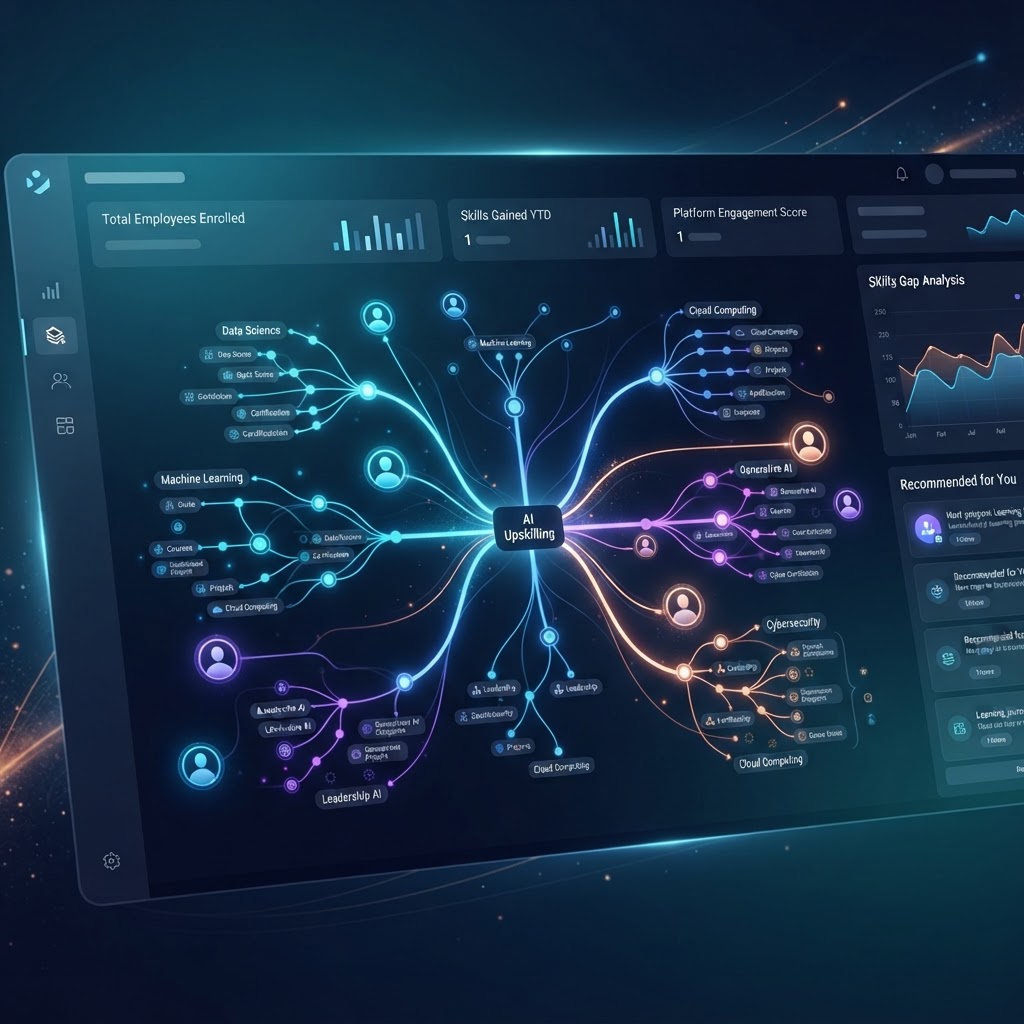
- AI-driven platforms have moved beyond simple LMS functions, shifting toward predictive workforce analytics and adaptive content delivery.
- Addressing the AI skills gap requires moving from static curricula to dynamic, role-specific pathways that evolve in real-time.
- Top-tier corporate upskilling tools must offer integration with existing human resource information systems (HRIS) to automate progress tracking.
- Personalization engines use generative AI to tailor micro-learning modules based on individual employee performance and business objectives.
- Choosing the right software depends on balancing broad technical skill acquisition with industry-specific competency mapping.
As we navigate the mid-2020s, the traditional “training manual” model has become a relic of the past. The rapid evolution of generative models, autonomous agents, and predictive analytics has fundamentally altered the professional landscape, leaving many enterprises scrambling to keep their workforce relevant. By 2026, the adoption of AI employee upskilling platforms is no longer a strategic advantage but an operational necessity for firms aiming to maintain competitive velocity. These systems do more than host video tutorials; they function as intelligent infrastructure, mapping individual performance against global market demands to ensure that every hour spent learning contributes directly to enterprise output. For organizations looking to bridge the widening competency chasm, selecting the right AI-powered learning platforms is the defining challenge of the current fiscal year.
1. Why AI is Transforming Corporate Upskilling in 2026
The acceleration of workplace technology has created a paradox: while tools have become more sophisticated, the workforce tasked with operating them is often hindered by legacy skill sets. By 2026, corporate upskilling tools have transcended their origins as simple video libraries, becoming sophisticated engines that integrate directly into the daily workflow. The transformation is driven by the realization that manual curriculum development—where L&D (Learning and Development) teams spend months designing a course—is far too slow for the current pace of AI development.
Modern AI employee upskilling platforms utilize machine learning to observe how work is actually performed within an organization. They ingest data from project management tools, communication suites, and internal repositories to understand what high-performing employees are doing differently. By identifying these patterns, the AI can synthesize training materials that address specific, immediate technical requirements. This move away from generalized professional development toward precision-based training is perhaps the most significant shift in workforce training software over the past few years.
Furthermore, these platforms have introduced the concept of “continuous readiness.” Rather than scheduling annual or quarterly training sprints, employees receive continuous, bite-sized learning interventions. This methodology minimizes the “forgetting curve” that often plagues legacy training methods. When an employee is struggling with a specific Python library or a complex CRM workflow, the platform identifies the friction point and offers a relevant, interactive tutorial instantly. This shift is critical because, by 2026, the half-life of a technical skill is shorter than ever. Employees must be in a constant state of micro-evolution, and AI is the only tool capable of managing the scale and individualization required to support this at an enterprise level.
From an organizational perspective, this transformation provides unparalleled visibility. Executives are no longer flying blind when it comes to human capital readiness. AI-powered dashboards provide a real-time pulse of the organization’s total capability, identifying which teams are ready to adopt new technologies and which require further support. By removing the guesswork from L&D, these platforms allow HR departments to pivot from being administrative cost centers to strategic architects of the company’s future capabilities. As we explore the top 5 tools later, it is this capacity for actionable, real-time insight that distinguishes the market leaders from the standard learning management systems of yesterday.
2. How AI Platforms Identify Critical Skills Gaps
The primary hurdle in any large-scale workforce evolution is identifying precisely where the gaps exist. Relying on self-reported surveys or rudimentary annual reviews is an outdated practice that frequently misses the nuance of specialized technical roles. AI skills gap analysis platforms solve this by leveraging natural language processing (NLP) to map individual employee proficiencies against the evolving requirements of the job market.
When deployed, these platforms typically perform an “inventory” of existing talent. They analyze an employee’s work history, project outcomes, and recent technical contributions. The system then matches this profile against the requirements for their current role, as well as the requirements for future roles within the organization. This creates a “delta” or gap analysis that is not based on opinion, but on observable evidence. For instance, if an engineering team is shifting toward a specific architecture, the platform analyzes existing commits and documentation to determine who has mastered the required skills and who needs targeted intervention.
This process is dynamic and iterative. As the technology landscape shifts, the definition of a “skilled” employee shifts with it. By integrating with the broader digital ecosystem of the company—including code repositories, collaborative whiteboards, and client engagement logs—AI platforms capture the silent data of work. They notice when an employee is spending an excessive amount of time searching for documentation, or when they are struggling to implement a specific feature in a way that suggests a lack of familiarity with current best practices. These small, observable events provide the data points necessary for the AI to recommend specific, high-impact learning paths.
The value here is the move from reactive to predictive identification. Rather than waiting for a project to fail due to a lack of technical capability, the platform alerts management to potential gaps before they become critical bottlenecks. This preemptive capability allows for proactive hiring or targeted upskilling, effectively neutralizing the risk of project stalls. By automating the auditing process, firms ensure that their employee development AI is always synchronized with the actual technical requirements of the business, preventing the common issue of employees spending time on certifications that do not contribute to the company’s specific growth trajectory.
3. Personalized Learning Paths for Every Employee
Personalization is the cornerstone of effective modern training. In a 2026 enterprise environment, “one size fits all” is equivalent to “one size fits none.” The most advanced employee development AI tools act as virtual coaches, curating a unique learning journey for every staff member based on their unique baseline, their preferred learning style, and the specific outcomes required by the company.
The engine behind these personalized paths is typically a recommendation system similar to those found in consumer entertainment platforms, but constrained by the rigorous requirements of professional competency. When an employee logs in, the platform does not present a linear course catalog. Instead, it presents a prioritized list of activities. An employee who already has a firm grasp of generative AI ethics but lacks experience in data cleaning, for example, will be routed past the foundational theory and straight into hands-on laboratory exercises regarding data preparation.
This personalization also accounts for the “flow” of work. The system learns when an employee is most productive and when they have capacity for deep learning. If the platform detects that a user is swamped with high-priority deliverables, it may shift to delivering micro-content—two-minute clips or interactive snippets—rather than deep-dive modules. This synchronization with the employee’s mental load is a game-changer for engagement rates, which historically suffer when training is forced upon a busy schedule.
Furthermore, personalization in 2026 extends to the medium of instruction. Some employees learn best through interactive coding sandboxes, while others prefer immersive role-playing simulations or short-form video synthesis. The best AI-powered learning platforms dynamically generate or select the format that has been shown to produce the highest retention rates for that specific individual. By treating each employee as a unique learner, these platforms dramatically increase the efficiency of the upskilling process, ensuring that the time invested leads to genuine, measurable competence rather than just a certificate of completion stored in an employee file.
4. Key Features to Look for in Upskilling Software
As the market for corporate upskilling tools saturates, distinguishing the high-utility platforms from the marketing fluff is essential for decision-makers. Not all AI is created equal; some systems are simply wrappers for static content, while others possess genuine cognitive capabilities to adapt and predict. When evaluating these systems, stakeholders must look for a specific suite of technical and pedagogical features that demonstrate a platform’s ability to facilitate long-term workforce readiness.
First and foremost is the strength of the platform’s integration layer. An upskilling tool that lives in a silo is a failed tool. It must be able to ingest data from your company’s HRIS (Human Resource Information System), project management software, and developer environments. If the platform cannot “see” the work being done, it cannot provide meaningful recommendations. Look for robust API connectivity and pre-built integrations for industry-standard suites.
Second, verify the capability for “Sandbox-based” or “Environment-specific” training. Theoretical knowledge is rarely sufficient in a modern tech-driven role. The best tools provide virtualized, browser-based environments where employees can actually execute code, configure networks, or navigate software interfaces within the training tool itself. This minimizes the friction between learning a skill and applying it in the field.
Third, examine the platform’s reporting and analytics dashboard. As a leader, you need to see more than just “completion rates.” You should be looking for “competency velocity”—how quickly is an employee moving from novice to expert in a given skill? Can the platform correlate training progress with project performance outcomes? This level of granularity is what allows for true ROI calculation on your upskilling budget.
Finally, consider the flexibility of the content generation. Does the system allow for the upload of internal proprietary documents to serve as the basis for training? If you have unique internal workflows or highly specialized software that no external company teaches, the ability for the AI to ingest your internal knowledge base and turn it into a structured training module is the hallmark of a top-tier platform. Below is a comparison table that highlights how different approaches to these features cater to specific organizational needs.
| Platform Type | Core Strength | Best For |
|---|---|---|
| Enterprise-Wide AI Suite | Deep HRIS integration & global analytics | Large firms requiring centralized oversight |
| Technical/Developer Focused | Live coding sandboxes & real-time feedback | Engineering & IT development teams |
| Content Synthesis Engines | Rapid internal knowledge transformation | Startups with unique, evolving workflows |
| Adaptive Soft-Skill AI | NLP-driven roleplay & simulation | Sales, management, & customer success |
5. Top 5 AI Employee Upskilling Platforms Compared
Selecting from the current crop of workforce training software requires a balanced assessment of technical rigor and administrative ease. By 2026, the market has settled into a few dominant archetypes that cater to specific needs. Whether your goal is to retrain a legacy workforce to handle AI-integrated business processes or to sharpen the technical edge of your software development department, there is a specialized tool optimized for the task. In this section, we analyze five leading contenders that have set the benchmark for AI-driven upskilling.
When assessing these platforms, consider not just the library of courses they offer, but the intelligence of their pathing algorithms. A platform with 10,000 courses is useless if it cannot direct your employees to the correct 10. The leaders in this space are those that prioritize the “curation of relevance” over the “accumulation of content.”
The first tier of platforms, often preferred by enterprise organizations, focuses heavily on the “Total Talent Management” approach. These systems are designed to exist at the intersection of HR strategy and departmental execution. They don’t just assign training; they monitor project outcomes. If a team is consistently failing to hit sprint velocity, these platforms can suggest cross-training modules that address the underlying technical friction. They essentially act as an automated diagnostic tool that keeps the enterprise aligned with its goals.
The second tier is comprised of highly specialized technical training environments. These platforms are the gold standard for engineering-heavy firms. By providing actual cloud-based environments—where a user can spin up a server, write code, and observe the results in real-time—they move training from the realm of passive viewing to active application. This is the difference between reading a textbook on carpentry and actually building a chair. For organizations where deep technical competence is a primary driver of revenue, these platforms are often the clear choice despite a steeper learning curve for the end-user.
As we examine these five contenders, we will look at their specific strengths, their integration capabilities, and the environments for which they are most suited. Remember that the “best” platform is the one that minimizes the delta between the desired skill set and the current organizational reality, while also respecting the limited time of your professional staff. A high-quality platform should, in theory, feel less like a “course” and more like an intelligent assistant that is helping the employee become better at their actual job, one task at a time.
Integrating AI Training Tools with HR Systems
The successful deployment of AI employee upskilling platforms is rarely a standalone endeavor. To derive maximum value from these systems, they must function as an integrated layer within your existing HR technology stack. When your learning ecosystem communicates fluidly with your Human Resources Information System (HRIS) and Applicant Tracking System (ATS), you create a unified thread of employee data that informs everything from recruitment to succession planning.
Most enterprise-grade AI powered learning platforms offer robust APIs and pre-built connectors to mainstream HRIS providers. The primary benefit of this integration is the automation of user lifecycle management. When a new hire is added to your HRIS, they should be automatically provisioned within your training software, assigned specific learning pathways based on their job role, and granted access to relevant compliance modules without manual administrative intervention.
Beyond simple user synchronization, integration facilitates skills-based talent management. By mapping the data generated within your AI training software back to your HRIS, you can automatically update employee profiles with newly acquired competencies. This transforms your HR database from a static repository of personal information into a dynamic, real-time map of your organizational capabilities. If an employee completes an advanced certification in generative AI prompt engineering via your platform, that skill should ideally reflect in your talent management dashboard, making the employee more visible for internal mobility opportunities.
Furthermore, deep integration allows for contextual learning. For example, when a performance review cycle is initiated in your HR software, the AI training platform can surface “gap-filling” content recommendations directly within the review interface. If a manager identifies a deficiency in project management skills during a review, the integrated system can automatically suggest a specific micro-learning module, closing the feedback loop instantly.
Measuring the ROI of AI-Driven Employee Development
Quantifying the return on investment (ROI) for corporate upskilling tools has historically been a challenge for L&D departments, often relying on vanity metrics like “course completion rates.” However, in 2026, the focus has shifted toward business-impact metrics that correlate directly with organizational health. Measuring the ROI of AI-driven development requires a multi-layered approach that tracks both individual growth and aggregate performance.
First, analyze “Time-to-Competency.” By tracking how quickly employees progress from introductory content to advanced certification within the platform, you can establish benchmarks for new hire onboarding. If the average time to reach full productivity decreases after the adoption of your AI training software, you have a concrete metric for productivity gains. This data can be correlated with the salary cost of the onboarding period to show tangible savings.
Second, monitor internal mobility and retention rates. AI platforms are exceptionally good at identifying employees who are stagnant and engaging them with personalized development tracks. High-potential employees who engage regularly with upskilling tools are statistically more likely to seek internal promotions rather than external opportunities. By comparing the turnover costs of trained vs. untrained cohorts, organizations can often identify significant savings in recruitment and replacement expenses.
Third, utilize AI skills gap analysis to calculate “Risk Mitigation Value.” By identifying critical skill shortages—such as cybersecurity awareness or AI ethics—the platform provides a hedge against potential operational failures. Quantifying the potential cost of a data breach or a compliance violation and contrasting that with the cost of the training software provides a clear risk-based argument for the investment.
Finally, track the “Application of Knowledge.” Modern workforce training software often includes features that allow managers to rate the practical application of learned skills. By aggregating these manager sentiment surveys alongside performance data (such as improved output quality or efficiency), you can build a compelling case for the effectiveness of the training program beyond the digital screen.
How to Choose the Right Platform for Your Team Size
Selecting the right platform is rarely about choosing the “biggest” or “most famous” option; it is about finding the software that aligns with your operational cadence, administrative bandwidth, and team structure. Below is a comparison of how different platforms cater to various organizational tiers.
| Platform Category | Primary Feature Focus | Best For |
|---|---|---|
| Agile AI Hubs | Rapid content deployment and UI flexibility | Startups and Scale-ups (10-200 employees) |
| Enterprise Suites | Deep integrations, compliance, and global scaling | Mid-Market (200-2,000 employees) |
| Global Learning Clouds | Advanced analytics, talent mapping, and multi-language support | Enterprises (2,000+ employees) |
| Skill-Specific AI Platforms | Niche technical mastery and AI-powered simulation | Technical teams and specialized R&D departments |
For smaller teams, look for platforms that emphasize “out-of-the-box” functionality. You likely do not have a dedicated L&D administrator to manage complex learning hierarchies. Instead, prioritize software that uses AI to automate curation so your employees can start learning on day one without you having to build content from scratch.
For mid-market organizations, the priority shifts toward administrative automation and robust reporting. You need a platform that can handle complex user permissions and integrate with your existing HR stack to reduce manual data entry. Look for vendors that offer dedicated customer success managers, as your needs will evolve quickly as your workforce grows.
For large-scale enterprises, architecture is king. You need a platform that supports decentralized content creation—where department heads can manage their own training tracks—while maintaining a centralized view for leadership. Scalability, rigorous data security compliance (e.g., GDPR, SOC2), and the ability to customize AI models to recognize your company’s internal jargon are essential requirements.
Automating Content Curation for Continuous Learning
The greatest barrier to consistent employee development is the “content fatigue” that sets in when employees are presented with static, outdated, or irrelevant materials. Employee development AI is solving this by transitioning from manual curriculum building to automated, dynamic content curation. The goal is to provide a “Netflix-style” experience where the platform suggests high-value learning content based on an employee’s current role, past performance, and future career aspirations.
Automation in this space works through a process of “Skills-Content Mapping.” The AI scans the open web, reputable academic databases, and your internal proprietary documentation to identify content that addresses specific skill sets. It then categorizes this content by difficulty level and format. If an employee indicates an interest in “Data Ethics,” the AI pulls the most relevant articles, video tutorials, and interactive exercises, presenting them in a digestible, sequential format.
Furthermore, these systems can generate summaries and quizzes based on long-form content. An AI agent can take a 60-minute industry webinar, transcribe it, distill the core concepts, and produce a five-minute summary with an embedded three-question assessment to ensure understanding. This significantly lowers the barrier to entry for busy professionals who cannot dedicate large blocks of time to training but want to stay current in their field.
Another layer of automation involves “Adaptive Pacing.” If the AI identifies that an employee is struggling with a particular concept, it can automatically trigger supplementary “remediation” content. Conversely, if an employee demonstrates high proficiency, the AI skips the basics and pushes more challenging, advanced modules. This ensures the learning experience remains engaging, reducing the dropout rates often associated with rigid, linear training modules.
Future Trends in AI-Powered Workforce Readiness
As we move toward the latter half of the decade, the concept of “training” will undergo a radical metamorphosis. The future of AI skills gap analysis is not just in identifying what an employee lacks, but in predicting the skills they will need before they even realize it themselves. We are moving toward a paradigm of “Just-in-Time” learning, where the AI anticipates a task requirement and provides the training in the flow of work.
One emerging trend is the integration of Augmented Reality (AR) and Virtual Reality (VR) simulations managed by AI. Imagine an employee learning to operate complex, high-stakes machinery. The AI monitors their hand movements and decision-making in a virtual environment, providing real-time feedback and adjusting the difficulty of the scenario based on their stress levels and performance. This is the ultimate form of “experiential learning” at scale.
Another trend is the emergence of “AI Career Agents.” Rather than a traditional manager-led career pathing process, employees will have access to an AI coach that acts as a career concierge. This agent will analyze internal job trends, external industry demands, and the employee’s unique strengths to propose long-term development plans. It will suggest specific projects they should request, connections they should make, and certifications they should earn to hit their career goals within the organization.
Finally, we expect a massive shift toward “Interoperable Skills Credentialing.” As AI platforms become more sophisticated, they will begin to issue verified digital badges that are recognized across industries. This could potentially transform the labor market, allowing employees to carry their verified AI-trained skills from one organization to another, creating a more fluid and transparent workforce ecosystem.
Frequently Asked Questions
How does AI help in identifying skill gaps within a workforce?
AI platforms conduct continuous skills gap analysis by mapping an employee’s existing profile, completed tasks, and performance reviews against the requirements of their current role and target future roles. By using machine learning to parse job descriptions and organizational goals, the AI identifies discrepancies and highlights which skills are missing across specific departments or the company at large.
Can AI training platforms replace traditional classroom-based instruction?
While AI platforms provide efficiency and scalability that traditional classrooms cannot match, they rarely replace human-led instruction entirely. Instead, they typically complement it. The best practice is a “blended learning” approach, where AI manages the foundational, technical, and theoretical aspects of training, while human instructors focus on complex discussions, mentorship, and the application of soft skills that require interpersonal nuance.
Are AI-powered learning platforms secure regarding employee data?
Enterprise-grade platforms prioritize data security by adhering to strict regulatory frameworks such as GDPR, SOC2, and HIPAA. These platforms typically offer features like role-based access control (RBAC), data encryption, and local hosting options. When evaluating a vendor, it is essential to review their data processing agreement to understand how they use, store, and protect your organizational and employee-specific data.
What is the most common reason AI training implementations fail?
Implementation failure is most often tied to a lack of change management rather than technical shortcomings. If leadership does not actively promote the value of the platform, or if the training is not tied to tangible career progression, employees may view it as an additional, optional burden. Success requires a culture that rewards continuous learning and integrates training time into the workday.
How much customization is possible within these platforms?
Most AI powered learning platforms allow for high levels of customization, ranging from white-labeling the interface to match your corporate branding to integrating your own proprietary training documentation. Advanced platforms also allow you to train the AI on your internal jargon and specific business processes, ensuring that the curated content is hyper-relevant to your unique operational context.
Do these platforms work for non-technical departments?
Absolutely. While these platforms are essential for tech-heavy teams, they are equally valuable for marketing, sales, human resources, and customer success departments. The AI can curate training on topics such as communication, leadership, industry trends, and compliance, ensuring that all employees—regardless of their technical proficiency—have access to personalized, growth-oriented learning content.
Conclusion
The landscape of workforce development is changing rapidly. As we navigate the complexities of 2026, relying on static, once-a-year training cycles is no longer sufficient to remain competitive. By leveraging the best AI employee upskilling platforms, organizations can transform their learning culture from a passive administrative burden into a proactive engine for growth. The ability to identify skill gaps, automate personalized content delivery, and measure real-world performance is the definitive edge for the modern corporation.
The path forward is clear: choose a platform that integrates deeply with your current HR systems, prioritizes a data-driven approach to ROI, and fosters a continuous learning environment. The investment you make in your employees’ skills today will pay dividends in resilience, innovation, and retention tomorrow.
Ready to elevate your team’s performance? Review your organization’s primary skill needs, check our comparison tables to identify the platform category that fits your size, and book a live demo with at least three vendors before committing to a long-term contract. The future of your workforce starts with the learning tools you provide them today.
By aismarttoolsreview Editorial Team
Leave a Reply