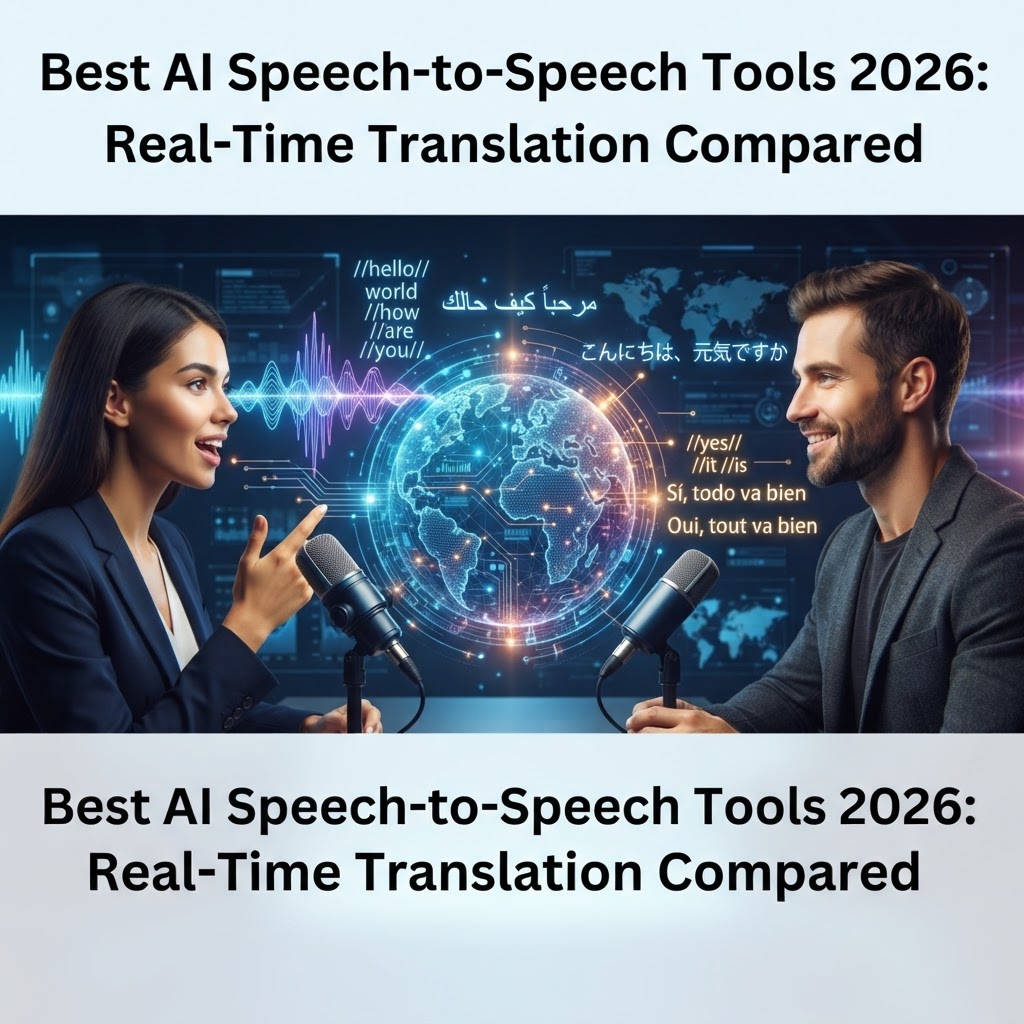
- AI speech-to-speech translation utilizes neural architectures to convert spoken input into a different target language while preserving original speaker characteristics.
- Latency, prosody preservation, and support for low-resource languages are the primary benchmarks for evaluating professional-grade voice translators.
- ElevenLabs leads in vocal nuance, while platforms like Rask.ai and HeyGen dominate the video-first dubbing market with automated lip-syncing.
- Mobile solutions like DeepL and Google Translate have transitioned from text-only utilities to sophisticated conversational tools capable of offline processing.
- Successful implementation of real-time voice translation requires a balance between computational speed and the contextual accuracy of Large Language Models.
The landscape of cross-lingual communication has shifted dramatically, moving away from slow, text-based manual translation toward seamless, instantaneous audio-to-audio interaction. In 2026, AI speech-to-speech translation has become a core utility for global enterprise, creative production, and personal travel. Unlike traditional translation methods that force users to read screens, modern AI audio translators act as a invisible layer between interlocutors, capturing the emotional cadence and intonation of a speaker and mapping them onto a new linguistic framework in real-time. This guide examines the leading architectures, features, and software contenders defining the current state of automated speech translation, helping you decide which technology best serves your specific workflow requirements.
How AI Speech-to-Speech Translation Technology Works
At the core of modern AI speech-to-speech translation lies a sophisticated pipeline known as the “Speech-to-Speech” (S2S) architecture. Unlike earlier, cascading systems that functioned as an assembly line—first transcribing audio to text (ASR), then translating the text (MT), and finally synthesizing the translated text back into audio (TTS)—modern state-of-the-art models often use end-to-end neural pipelines. These advanced architectures operate on the principle of direct acoustic-to-acoustic mapping, which significantly reduces the errors that traditionally plague cascaded systems, such as misinterpretations of slang or the loss of sentence-level context.
The process begins with an encoder, typically a transformer-based model trained on massive datasets of speech audio. This encoder decomposes the incoming waveform into a sequence of acoustic tokens. These tokens capture not only the semantic content but also the stylistic elements, often referred to as “paralinguistics”—the pitch, speed, and emotional inflection of the speaker. By encoding these features into a high-dimensional vector space, the AI can maintain the “vibe” of the original voice, even as it translates the actual words into the target language.
Once the audio is digitized and contextually analyzed, the system passes this information to the translation engine. Here, the AI acts as a sophisticated translator that understands cultural idioms rather than just direct vocabulary equivalents. If a speaker uses a metaphor in their native language, the model is often intelligent enough to select the most relevant cultural equivalent in the target language. The final stage is the neural vocoder, which reconstructs the waveform from the translated token sequence. This is where the magic of “voice cloning” often happens, as the vocoder applies the stored prosodic features of the original speaker onto the translated sentence.
The complexity of this process is immense, which is why early versions of these tools suffered from high latency. Today, developers utilize “streaming” architectures. Instead of waiting for a full sentence to be spoken, the AI processes audio in small, overlapping buffers of a few hundred milliseconds. This approach allows for real-time voice translation, where the translated output begins playing shortly after the speaker starts talking. However, this creates a massive computational demand. As the translation happens, the system must balance accuracy with speed. If the model is too “thorough,” the latency makes conversation unnatural; if it is too fast, grammatical errors increase. Achieving this equilibrium is the hallmark of the top-tier solutions currently dominating the market in 2026.
Key Features to Look for in Real-Time Voice Translators
Selecting the right AI audio translator requires more than just checking which languages are supported. Because real-time translation is a task-specific operation, the environment in which you are working determines the necessary feature set. When evaluating tools, experts generally look at four critical metrics: latency, voice preservation fidelity, emotional range, and offline capability.
Latency is arguably the most critical feature. In a professional setting, such as a diplomatic meeting or a high-stakes business negotiation, a delay of even three seconds can destroy the flow of conversation. Look for tools that leverage edge computing or highly optimized cloud infrastructure. The best tools utilize predictive buffering, which allows the AI to start generating audio for the beginning of a phrase while the speaker is still finishing the rest of the sentence. This “pre-translation” capability significantly reduces the cognitive load on the listener.
Voice preservation is the second pillar of quality. If you are using a tool for content creation or customer service, you want the recipient to hear a voice that sounds like the original speaker. Look for systems that offer “Voice Cloning” or “Voice Preservation” features. These tools analyze your vocal timbre and apply it to the generated speech. Conversely, for quick travel assistance, you might prefer a standardized, neutral voice that is easy to understand regardless of the ambient noise level. Versatility here is key: a good application should allow you to toggle between personal identity preservation and utilitarian speech synthesis.
Contextual awareness and cultural adaptation are features often overlooked by casual users. A superior AI speech-to-speech translation tool does not just swap words; it understands the specific domain. If you are discussing technical medical terminology or intricate legal clauses, the software should allow you to upload a glossary or define a “tone” (e.g., formal, casual, or urgent). This ensures the translation remains precise even when the source material is highly specialized.
Finally, consider the environmental adaptability of the software. Many real-time translation apps fail when used in loud environments like airports or busy city streets. Advanced tools now incorporate noise suppression and speech isolation, which filter out background clutter before the translation process begins. Below is a summary table comparing the various approaches to these core features, helping you identify which tool architecture aligns with your specific needs.
| Tool/Category | Core Strength | Best For |
|---|---|---|
| ElevenLabs | High-fidelity voice synthesis | Creative dubbing & content creators |
| Rask.ai / HeyGen | Visual lip-sync integration | Video marketing & e-learning |
| DeepL / Google | Fast, broad-language utility | Real-time travel & conversation |
| Local LLM Apps | Offline privacy & speed | High-security & remote environments |
ElevenLabs Speech-to-Speech: Is It the Market Leader?
When discussing the current state of vocal technology, ElevenLabs often emerges at the top of the conversation. Originally gaining fame for its high-quality text-to-speech (TTS) capabilities, the platform has matured into a powerful speech-to-speech (S2S) engine that has redefined how creators approach multilingual content. Unlike standard translation apps that force a synthetic, robotic voice onto the user, ElevenLabs focuses on the preservation of the “soul” of the voice—the subtle variations in volume, breath, and pace that make speech sound human.
The primary reason ElevenLabs holds such a prominent position is its mastery of prosody. In traditional automated speech translation, the system often struggles with rhythm. A sentence in Japanese might be translated into English, but if the cadence remains Japanese-influenced, the listener experiences a “cognitive dissonance” that makes the speech difficult to process. ElevenLabs solves this by utilizing a sophisticated neural network that interprets the intent behind the spoken input and then regenerates it in the target language with the native cadence of that language, while simultaneously maintaining the timbre of the original speaker’s voice.
This capability is game-changing for content creators and filmmakers. Imagine a YouTuber recording a video in English and needing to release it to audiences in Spanish, Hindi, and German. Instead of spending weeks in a recording studio with voice actors, the creator can upload their original audio and, using ElevenLabs, translate the content while keeping their own voice identity consistent across all languages. The result is a video that feels personal and authentic, as if the creator themselves were fluent in every language they publish in.
However, the question of whether it is the “market leader” depends on the use case. If you are prioritizing raw emotion and vocal quality, it is arguably unmatched. But for users who need a tool that handles full-scale live conversation, there are limitations. ElevenLabs is primarily an asynchronous tool. It excels in post-production and recorded content, whereas its performance in a truly live, low-latency conversational environment is still evolving. While it offers an API that developers can use to build real-time applications, the computational cost to generate that high-fidelity audio on the fly remains quite high. For a casual user looking to translate a street-side conversation in Paris, ElevenLabs might be overkill; for a brand looking to scale their digital presence globally, it is likely the gold standard.
HeyGen vs. Rask.ai: Best Tools for Video Dubbing Translation
Video is the primary medium for modern communication, and as global audiences expand, the ability to localize video content without losing visual engagement has become a priority. HeyGen and Rask.ai have emerged as the two titans in this specific niche. Both platforms move beyond simple audio translation by tackling the “uncanny valley” of video dubbing—specifically, the challenge of lip-syncing. When you translate speech, the length and shape of the words change; if the speaker’s lips on screen do not match these new sounds, the illusion of communication breaks. This is where both platforms aim to excel.
Rask.ai has built its reputation on being an end-to-end powerhouse for creators and media agencies. Its “AI Dubbing” feature is particularly adept at handling multi-speaker scenarios. If you have a podcast video with three people, Rask.ai can identify each speaker individually and apply their unique voice profile across the translation. The platform is highly intuitive, allowing users to upload a video link and receive a fully localized version within minutes. The quality of the translation, when paired with their lip-sync technology, creates a seamless experience where the viewers almost forget they are watching a dubbed video.
HeyGen, on the other hand, approaches the market with a broader focus on high-end generative avatars and corporate solutions. Their “Video Translate” feature is renowned for its extreme attention to visual consistency. HeyGen’s technology doesn’t just overlay audio; it subtly modifies the facial movements of the speaker to match the phonemes of the target language. This is particularly effective in corporate training or high-end marketing videos where visual professionalism is non-negotiable. While Rask.ai feels like the ultimate tool for the “creator economy,” HeyGen feels like the enterprise-grade solution for companies that need perfect, polished, and scalable video communications.
Choosing between these two depends on your production volume and your specific visual requirements. Rask.ai is generally faster and better at handling the “messy” reality of organic, unscripted content like influencer videos or interviews. Its ability to preserve the raw energy of a conversation is excellent. HeyGen excels in highly controlled environments. If you are creating a product demo or a series of educational videos, the meticulous way HeyGen aligns lip movements to the translated script will likely provide a higher return on investment. Both are significantly ahead of the curve compared to manual dubbing, effectively collapsing what used to be a month-long post-production process into an afternoon of cloud-based processing.
Google Translate vs. DeepL: The Mobile App Showdown
For the average user, the true test of AI speech-to-speech translation is the mobile phone. When you are traveling through a foreign country, you do not have time for cloud-based video rendering or complex API configurations. You need an app that launches in under a second and translates a conversation while you are standing in a café. This is the battleground for Google Translate and DeepL—two giants that have successfully pivoted from text-only tools to powerful, pocket-sized AI audio translators.
Google Translate has a massive advantage in its sheer breadth of support. With dozens of languages covered and a deep integration into the Android and iOS ecosystems, it is the most ubiquitous choice. Google’s “Conversation Mode” is designed for simplicity. You tap a button, speak, and the app automatically detects the language and responds in the other. It is incredibly effective for basic logistics: asking for directions, ordering food, or checking into a hotel. Furthermore, Google’s massive investment in offline models means that even without a reliable 5G connection, their app can provide functional, albeit slightly slower, translations by running a compressed neural network directly on your phone’s processor.
DeepL, however, has taken a different route. While Google focuses on quantity, DeepL focuses on quality. Their translation engine is widely regarded by linguists as being significantly more nuanced, especially regarding context, tone, and sentence structure. When using DeepL for audio translation, the output feels less like a literal word swap and more like a fluent sentence. For users who need to conduct serious business conversations or explain complex ideas while abroad, DeepL often proves more reliable. The app is cleaner, with fewer interface distractions, allowing the user to focus on the speaker rather than the software UI.
The trade-off is clear: Google Translate is the ultimate tool for breadth and convenience, while DeepL is the choice for accuracy and linguistic sophistication. For casual travelers, Google’s extensive feature set—including camera-based sign translation and offline language packs—remains hard to beat. For professionals who are using their phone as a primary tool for conducting meetings on the fly, DeepL’s superior translation engine makes it a more reliable partner. Both apps have moved toward a “continuous” translation model, meaning they process speech in real-time as you speak, rather than requiring you to pause at the end of every sentence. This transition has rendered older, “push-to-talk” translation apps largely obsolete and set a new standard for what users should expect from their mobile devices.
Overcoming Latency Issues in Live Conversations
The primary barrier to seamless AI speech-to-speech translation remains latency—the delay between the speaker finishing a sentence and the target language audio output. In a professional setting, a delay exceeding two seconds often disrupts the natural flow of dialogue, leading to crosstalk and user frustration. Modern AI architecture tackles this via streaming inference, which processes incoming audio buffers in small segments rather than waiting for an entire sentence to conclude.
Developers are currently mitigating latency by utilizing edge computing. By processing the audio locally on the device’s Neural Processing Unit (NPU) rather than sending data to a cloud server, the round-trip time is significantly reduced. This approach requires highly optimized lightweight models, such as distilled versions of large transformer architectures, which maintain high accuracy while consuming fewer computational cycles. Furthermore, predictive modeling is gaining traction; these systems attempt to anticipate the syntactic structure of the speaker’s sentence as it unfolds, allowing the AI to initiate the translation process before the speaker has reached a full stop.
Another technique involves the use of asynchronous processing pipelines. In these setups, the system utilizes a “look-ahead” mechanism that analyzes phonetic patterns to begin generating the translated text stream immediately. By combining these methods, the best AI speech-to-speech translation platforms can now offer near-synchronous experiences, effectively minimizing the cognitive load on the participants and allowing the conversation to feel more like a human-to-human interaction.
Maintaining Emotional Nuance and Tone in Translation
Historically, automated speech translation suffered from “robotic” delivery, where the AI rendered text in a flat, monotonic pitch. However, current breakthroughs in Prosody Transfer and Expressive Voice Synthesis allow systems to analyze the speaker’s emotional state—identifying cues like sarcasm, excitement, or urgency—and map them onto the synthesized output in the target language.
To preserve emotional integrity, high-end AI audio translators utilize multi-modal embedding. The system doesn’t just process the semantic meaning of the words; it tracks pitch variance, temporal rhythm, and vocal intensity. When these acoustic features are fed into a decoder alongside the translated linguistic tokens, the resulting audio output carries a tone that mimics the speaker’s original intent. For example, if a speaker is apologizing sincerely, the AI preserves the downward pitch shifts and breathiness associated with empathy, rather than delivering the apology with a neutral, synthetic cadence.
This preservation of tone is critical for building rapport in cross-lingual communication. Experts generally agree that semantic accuracy alone is insufficient for negotiation or therapy sessions; the “vibe” of the conversation is often the deciding factor in mutual understanding. As these systems evolve, we are seeing the integration of “style tokens,” which allow users to define whether the output should sound professional, friendly, or authoritative, providing an extra layer of control over the interpreted delivery.
Use Cases for Business: Global Meetings and Support
The integration of AI speech-to-speech translation into the corporate ecosystem is revolutionizing how multinational organizations operate. In global boardrooms, automated speech translation tools are increasingly replacing human interpreters for internal stand-ups. These tools allow participants to speak in their native languages while everyone else listens to a real-time synthetic overlay in their preferred language. This lowers the barrier to entry for team members whose primary language is not English, fostering more inclusive and diverse meeting environments.
In customer support, these tools are creating “language-agnostic” call centers. Instead of routing a customer to a specifically trained native-speaking representative, companies can use AI to facilitate a conversation between an agent and a caller who speak completely different languages. This allows for massive scalability and reduces wait times. Below is a comparison of tools tailored for these high-stakes business environments:
| Tool Name | Primary Business Strength | Latency Profile | Best For |
|---|---|---|---|
| DeepL Pro Voice | Linguistic precision and context awareness | Low-Medium | Formal board meetings and legal discussions |
| Microsoft Azure AI Speech | Scalable API integration for call centers | Ultra-Low | Customer support and enterprise-wide deployment |
| Google Cloud Translation | Vast language support and fast inference | Low | Global team collaboration and internal messaging |
| ElevenLabs Speech-to-Speech | High-fidelity emotional/tone retention | Medium | Creative presentations and media production |
Best AI Tools for Offline Speech Translation
Not every environment provides a stable 5G or high-speed Wi-Fi connection. For travelers, field researchers, and professionals working in remote locations, offline speech translation capabilities are a prerequisite. These tools function by downloading compressed linguistic model packages directly to the smartphone or handheld device’s storage.
The trade-off for offline functionality is typically a slightly lower vocabulary range compared to cloud-based systems. However, for core communication—asking for directions, coordinating logistics, or conducting basic technical interviews—the quality is remarkably high. Apps like iTranslate and Microsoft Translator have pioneered the “offline pack” model, where users download language pairs (e.g., English to Japanese) ahead of time. These localized models utilize quantized neural networks, which are optimized to deliver decent accuracy without requiring a massive hardware footprint. The key for the best user experience is choosing a device with sufficient RAM to keep these models resident in active memory, preventing the stuttering that can occur when a phone struggles to juggle processing load.
Privacy and Security Considerations for Voice Data
Voice is a biometric identifier, and transmitting it to a cloud server for translation introduces significant security risks. Corporations and privacy-conscious users must evaluate the data retention policies of any AI audio translator they employ. Many providers now offer “Zero Data Retention” agreements, meaning the audio samples and translated transcripts are processed in volatile memory and deleted immediately after the session ends.
End-to-end encryption is the gold standard for these tools. This ensures that the raw audio stream, which contains the speaker’s unique vocal characteristics, cannot be intercepted or reconstructed by the service provider. Furthermore, users should look for platforms that allow for “On-Premise” or “Private Cloud” deployments. By hosting the translation model within the company’s internal network, organizations ensure that proprietary conversation data never crosses their firewall, maintaining compliance with global data protection regulations like GDPR or CCPA. Always audit the API documentation to see if your data is being used to train the provider’s future models; if it is, the tool may not be suitable for high-security, classified business discussions.
Frequently Asked Questions
Can AI speech-to-speech tools translate dialects or regional accents accurately?
Modern AI models are increasingly proficient at recognizing regional dialects. By training on vast, diverse datasets, developers have improved the AI’s ability to normalize various accents. However, extreme regional variations can still occasionally cause confusion, particularly in languages with significant tonal differences.
Do I need an internet connection for real-time translation to work?
While cloud-based tools offer the highest accuracy and broadest language support, many platforms now offer offline modes. These offline packages are specifically designed to work without an internet connection, though they may have a smaller vocabulary and less nuanced emotional detection than their online counterparts.
How does AI speech-to-speech translation handle technical jargon?
Many professional-grade translation platforms allow users to upload custom glossaries. By pre-loading specific industry terminology, technical abbreviations, and brand-specific jargon, the AI is much less likely to misinterpret specialized language, ensuring higher precision in fields like medicine, engineering, and law.
Is there a risk that my translated voice will be used for deepfakes?
Any system capable of cloning or synthesizing a voice carries inherent security risks. It is essential to select reputable providers that implement robust “watermarking” in their audio outputs. Additionally, ensure that your provider has strict policies against using user-submitted voice data for unauthorized voice modeling.
What is the difference between text-to-speech and speech-to-speech translation?
Text-to-speech translation involves typing or receiving text and having it read aloud by an AI. Speech-to-speech translation is more advanced, as it involves capturing the original audio, understanding the intent, and outputting new audio in the target language while maintaining the pacing and tone of the original speaker.
Can these tools translate multiple people talking at once?
Most standard AI translation apps struggle with overlapping speech. However, enterprise-grade meeting software often utilizes “speaker diarization,” a technology that segments audio based on who is speaking. This allows the AI to keep track of individual voices and translate them sequentially, even in a crowded meeting setting.
Conclusion
The landscape of AI speech-to-speech translation is moving at a breakneck pace, shifting from experimental novelties to essential pillars of global communication. By prioritizing tools that balance low-latency performance with robust privacy measures, users can effectively dismantle the language barriers that have historically hindered collaboration and human connection. Whether you are conducting a high-stakes business negotiation or navigating a foreign city, the technology available in 2026 offers unprecedented clarity and emotional resonance.
As these tools continue to mature, the focus will likely shift toward even deeper integration into our daily hardware—from smart glasses to earbuds that translate in real-time without needing a screen. Now is the perfect time to experiment with the tools we have discussed to see which fits your specific linguistic workflow. We encourage you to start with a trial version of a top-tier platform today to experience the future of borderless conversation for yourself.
By aismarttoolsreview Editorial Team
Leave a Reply