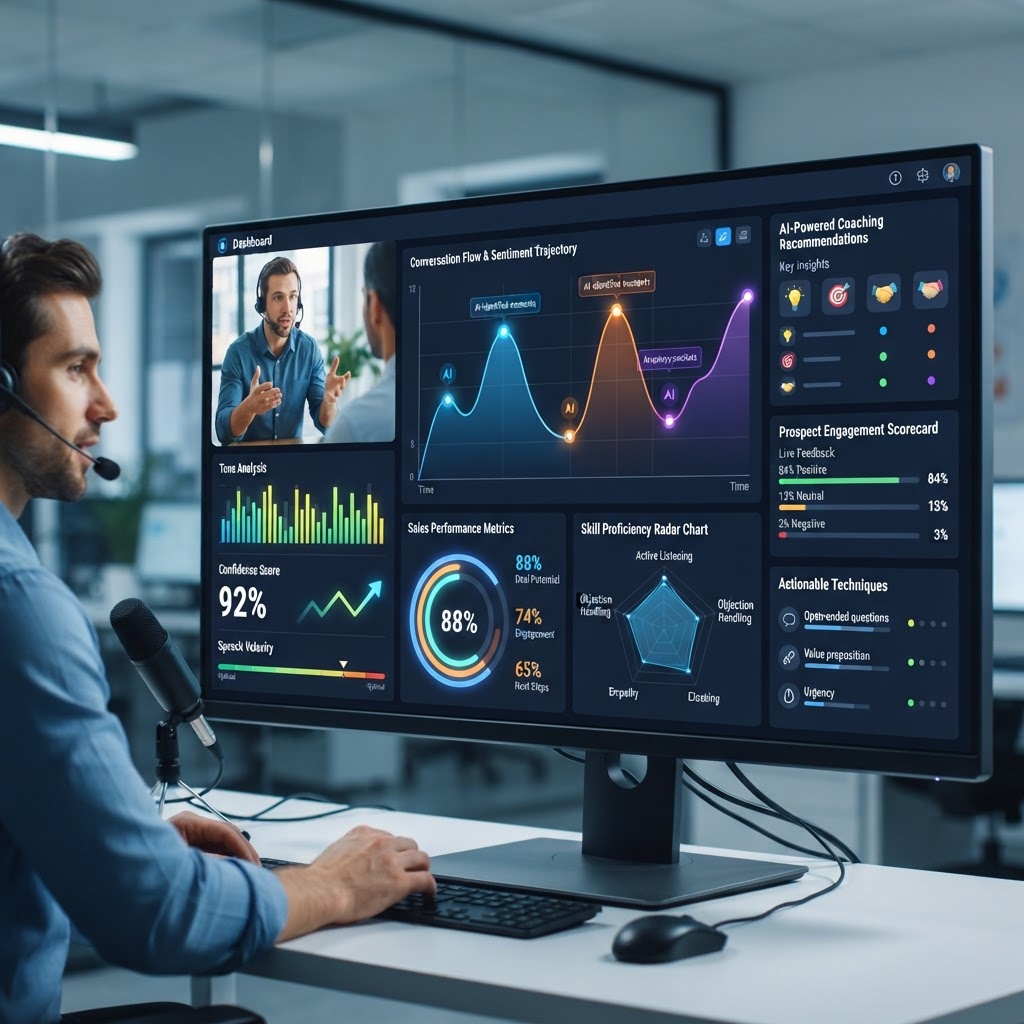
- AI sales coaching tools enable rapid skill acquisition by providing objective, data-driven feedback on every customer interaction.
- Conversational intelligence for sales transforms unstructured voice and video data into actionable insights for managers and reps.
- Top-tier sales performance software now integrates generative AI to automate roleplay, objection handling, and personalized coaching plans.
- Modern B2B sales coaching requires a balance between automated metrics and human oversight to maintain team morale and authentic communication.
- Choosing between leading platforms like Gong and Chorus.ai depends on your specific organizational scale, tech stack integration needs, and reporting requirements.
The modern B2B landscape has shifted from a reliance on gut instinct to a data-first approach, and nowhere is this more apparent than in sales enablement. As the pressure to shorten sales cycles and increase conversion rates intensifies, revenue leaders are turning to advanced AI sales coaching tools to standardize high-performance behaviors. By leveraging large language models and natural language processing, these platforms are no longer just recording conversations; they are actively shaping the future of sales execution. This guide examines the leading solutions available in 2026, offering a technical deep dive into how these platforms can elevate your team’s performance through precise, scalable, and personalized coaching.
Why AI Sales Coaching is Essential for Modern Teams
In the past, sales management was constrained by the “manager as bottleneck” model. A sales leader could only listen to a fraction of calls, leading to subjective feedback that often suffered from recency bias or incomplete information. Today, the adoption of AI sales coaching tools has effectively democratized high-level coaching, ensuring that every representative, regardless of tenure, has access to consistent performance guidance. The primary necessity for these tools stems from the sheer volume of data generated in digital sales environments. When a mid-sized B2B organization conducts hundreds of hours of discovery, demo, and closing calls monthly, manual review is mathematically impossible. Automated systems bridge this gap by auditing 100% of interactions, identifying patterns that a human ear might miss, such as the cadence of silence, the frequency of competitor mentions, or the specific phrasing that triggers a prospect’s hesitation.
Furthermore, AI sales training has become a critical pillar for remote and hybrid workforces. Without the ability to “tap a rep on the shoulder” in the office, sales leaders need a virtual feedback loop. These platforms provide an objective scoreboard for performance, which reduces the friction often associated with performance reviews. When a rep can see their own data—such as talk-to-listen ratios, sentiment scores, and discovery question completion—the coaching conversation shifts from a critique of character to a collaborative optimization of tactics. This data-driven culture fosters a sense of agency and accountability.
The economic impact of this transition is significant. Organizations that implement AI-driven coaching often see a reduction in the time-to-productivity for new hires, as they can emulate the behaviors of top-performing peers who have been benchmarked by the software. Moreover, as B2B buyers become more self-educated, the sales representative’s role has moved from information provider to strategic consultant. AI platforms assist in this transition by ensuring that reps are not just following a script, but are actively addressing the nuanced pain points surfaced during calls. By analyzing sentiment and intent, these tools ensure that reps maintain empathy and focus throughout long, complex sales cycles, which is arguably the most difficult skill to coach manually at scale. Ultimately, these systems act as a 24/7 force multiplier for sales enablement teams.
How AI Analyzes Sales Calls for Better Performance
Conversational intelligence for sales relies on a sophisticated stack of machine learning models designed to parse audio and video data into structured, readable intelligence. The process begins with automated transcription, which is the baseline requirement. However, modern platforms go far beyond simple text conversion. They utilize Natural Language Understanding (NLU) to identify “moments of truth”—specific sections of a call where pricing is discussed, objections are raised, or competitive intelligence is dropped. These platforms annotate calls in real-time or post-call, allowing managers to jump directly to the most critical portions of a negotiation rather than scrubbing through an hour-long recording.
The analysis layer is where the real value is extracted. These AI sales coaching platforms track specific KPIs, such as question-to-statement ratios, which are essential for effective discovery. If a rep dominates the conversation without letting the prospect speak, the AI flags the imbalance. Similarly, the software analyzes “talk-over” frequency, a key indicator of rapport building or impatience. When a prospect mentions a competitor, the platform automatically logs the mention, allowing the marketing and product teams to see real-time trends in competitive landscape shifts.
Advanced sentiment analysis also plays a role in identifying when a deal is at risk. By analyzing tone, pitch, and word choice, the AI can detect frustration or waning interest in a prospect’s voice. This is a game-changer for B2B sales coaching, as it allows managers to intervene before a deal stalls. Beyond individual metrics, these tools perform aggregate analysis. They can identify the common linguistic traits of winning calls across an entire department. For instance, if the data shows that top-performing reps use a specific hypothetical scenario during their value proposition phase, that behavior can be codified into a “playbook” or training module within the software. This creates a feedback loop where the highest performing tactics are captured, analyzed, and disseminated to the rest of the team without human manual intervention.
Key Features to Look for in Sales Coaching Software
When evaluating sales performance software, the sheer number of available features can be overwhelming. Organizations should prioritize functionality that drives actionable behavior change rather than just passive reporting. First and foremost, you need robust integration capabilities. The software must sync seamlessly with your CRM (like Salesforce, HubSpot, or Microsoft Dynamics) to map call intelligence to specific deal stages, revenue numbers, and rep performance quotas. Without this integration, the insights remain siloed, making it difficult to measure ROI.
Secondly, look for intelligent “snippet” or “highlight” capabilities. A manager should be able to create a library of best-practice calls—examples of perfect discovery, masterclass-level objection handling, or expert closing techniques—and share them with the team as part of an onboarding curriculum. Gamification is another powerful feature; when reps can see their own “leaderboard” metrics based on specific, coachable criteria, it encourages proactive self-improvement. Third-party integrations with video conferencing tools and email suites are also standard expectations for 2026. The ability to pull data from both sync (calls) and async (emails/Slack) interactions provides a holistic view of the customer relationship.
Finally, consider the accessibility of generative AI features. The current generation of coaching software includes AI-driven roleplay assistants. Instead of relying on a manager to roleplay a difficult negotiation, a rep can practice against an AI bot that is programmed to simulate specific buyer personas and objections. This provides a safe, repeatable environment for practice. Below is a breakdown of how different approaches to sales coaching software prioritize these various features for different organizational needs.
| Approach | Key Focus | Best For |
|---|---|---|
| Revenue Intelligence Platforms | Full-funnel data aggregation and forecast accuracy | Enterprise orgs with complex, high-volume sales cycles |
| Specialized Coaching Suites | Roleplay simulation, skill-based micro-learning | Fast-growing teams focused on ramping new hires |
| Conversation Intelligence (CI) | Deep linguistic analysis and call insights | Mid-market teams needing to improve core call skills |
Gong vs Chorus.ai: Choosing the Right Intelligence Platform
In the market for B2B sales coaching, Gong and Chorus.ai are widely recognized as the primary incumbents. While both platforms provide conversational intelligence for sales, they serve slightly different organizational needs. Gong has evolved into a comprehensive “Revenue Intelligence” platform. Its strength lies in its ability to synthesize data not just from calls, but from the entire CRM, email, and calendar ecosystem to provide a predictive view of revenue. For a Sales VP, Gong is less of a coaching tool and more of a “command center” for the entire revenue operation. It excels at identifying which deals are likely to close, which are at risk, and why, by correlating call sentiment with CRM data entries.
Chorus.ai, which was acquired by ZoomInfo, offers a distinct advantage regarding integration with high-intent lead data. Because it exists within the broader ZoomInfo ecosystem, it is particularly effective for teams that rely heavily on outbound prospecting and deep account research. The coaching interface is often described as more focused on the tactical level of the individual representative. For teams that want to dive deep into call metrics—like how many times a rep mentioned a specific value proposition or handled a pricing objection—Chorus provides a very granular, user-friendly experience that is often praised by front-line sales managers.
The choice between them often comes down to the depth of the revenue stack. If you are a large enterprise that needs to forecast revenue with high precision while coaching reps, Gong’s infrastructure is built for that top-down visibility. If you are an organization that is highly dependent on ZoomInfo for lead generation and wants a platform that maps coaching directly to the top of the funnel—prospecting calls and discovery—Chorus offers a tightly coupled solution that streamlines the workflow for BDRs and SDRs. Both platforms are investing heavily in generative AI, with features that now summarize calls and generate follow-up emails, so the competitive gap in features is closing rapidly. The decision should therefore be based on which interface your sales managers prefer and how effectively the platform integrates with your existing tech stack, as the “stickiness” of these tools is directly related to how much time your team spends within them each day.
Improving Sales Rep Onboarding with AI Guidance
The onboarding phase is arguably the most critical period for a B2B sales representative, and it is here that AI sales coaching tools provide the highest measurable ROI. Traditionally, onboarding involves a mix of shadowing senior reps, reading static documentation, and roleplaying with managers. This process is time-intensive and highly variable in quality. AI-driven onboarding transforms this into a scalable, repeatable, and data-backed curriculum. By using conversation intelligence, new hires can listen to a curated “playlist” of high-performing discovery and demo calls from their veteran counterparts. They aren’t just listening for flow; they are observing how top reps handle specific difficult questions or how they frame pricing to maximize value perception.
Modern platforms also enable “virtual roleplay” at scale. Instead of waiting for a manager’s availability, a new hire can engage with AI-powered coaching avatars. These avatars can be programmed to act as a skeptical prospect, an aggressive procurement officer, or a curious technical stakeholder. The AI assesses the representative’s response in real-time, checking for the inclusion of required messaging, tone, and logical flow. If the rep misses a key point or fails to address an objection, the AI provides immediate, objective feedback. This constant, low-stakes environment allows new hires to build “muscle memory” before they ever get on a live call with a real prospect.
Moreover, these tools allow for the objective measurement of a ramp-up period. Managers can track when a new rep starts hitting target metrics, such as talk time, question depth, and sentiment outcomes. Rather than relying on the “feeling” that a rep is ready to take live discovery calls, the manager has empirical data showing the rep has mastered the necessary skills. This data-driven onboarding approach significantly reduces the time-to-first-deal and minimizes the risk of early turnover. When new hires see that their development is being tracked and supported by technology, they often report higher job satisfaction and clarity, as they don’t feel left to “sink or swim” in the early months of their tenure.
Automating Feedback Loops for Better Closing Rates
The traditional sales coaching model often suffers from a significant latency problem: the gap between a sales call occurring and a coach providing actionable feedback is frequently too wide to be effective. By the time a sales representative receives critique, the nuance of the conversation has faded, and the opportunity for immediate self-correction is lost. AI sales coaching tools are fundamentally shifting this paradigm by automating feedback loops, turning post-call reflection into a real-time iterative process.
Automated feedback loops work by leveraging natural language processing (NLP) to parse call transcripts against high-performance benchmarks. When a representative deviates from a winning script, misses a critical discovery question, or fails to address a common objection, the AI generates a notification or an annotation within the platform. This removes the administrative burden on sales managers, who previously had to listen to hours of recorded audio to find the moments that mattered most. Instead, the AI highlights specific timestamps, providing a surgical approach to skill development.
Furthermore, these systems promote “self-coaching,” which is often more sustainable than manager-led intervention. When a rep receives a scorecard immediately after a meeting—complete with sentiment analysis and talk-to-listen ratios—they are empowered to reflect on their own performance. This internal feedback loop builds autonomy. Over time, these platforms use machine learning to identify patterns in a specific rep’s behavior, such as a recurring tendency to interrupt prospects or a failure to mention specific pricing tiers. By flagging these habits consistently, the AI acts as a 24/7 accountability partner, driving incremental improvements in closing rates that compound over the fiscal year.
Integrating AI Coaching with Your Existing CRM
For AI sales coaching tools to provide genuine value, they cannot exist as isolated silos. Their utility is maximized only when they are deeply integrated with your existing customer relationship management (CRM) ecosystem. Seamless integration ensures that the data being analyzed is contextual, pulling from customer history, deal stages, and previous interactions. When an AI tool understands the specific account health, it can provide more relevant coaching advice, such as identifying if a rep is ignoring red flags on an enterprise-level opportunity.
Most modern AI sales coaching platforms offer native connectors for major CRM systems, allowing for automated data syncing. This integration allows for “performance mapping,” where the software correlates specific coaching insights with actual deal outcomes. If a rep consistently receives coaching on “value proposition articulation” and subsequently sees a reduction in deal cycle duration, the CRM provides the empirical evidence to prove the efficacy of the coaching. This technical marriage of data allows sales leadership to identify which training modules lead to actual revenue movement rather than just vanity metrics like call volume.
| Integration Capability | Best For | Key Benefit | |
|---|---|---|---|
| Bidirectional API Sync | Enterprise B2B Teams | Automated deal updates based on call insights. | |
| Native Plug-in | Mid-market Sales Teams | Quick setup with minimal IT overhead. | |
| Webhook Automation | High-velocity Sales Teams | Custom triggers for specific call outcomes. | |
| Legacy System Middleware | Organizations with Custom CRMs | Data pipeline flexibility and data integrity. |
Beyond simple data syncing, successful integration often involves workflow automation. For example, if an AI coaching platform detects that a rep has mishandled a pricing objection, it can automatically trigger a task within the CRM for the manager to review that specific call or assign a mandatory micro-learning module. This turns passive data into active management workflows, ensuring that coaching is never “out of sight, out of mind.”
Measuring the ROI of AI-Powered Sales Training
Demonstrating the return on investment (ROI) for AI sales training is a frequent challenge for sales enablement leaders. Unlike a direct software purchase that yields immediate efficiency, AI coaching is an investment in human capital. To measure it effectively, organizations must look beyond anecdotal success stories and focus on quantifiable sales performance metrics that have been normalized over a reasonable timeline.
A primary KPI for evaluating these platforms is the “Time to Productivity” for new hires. By utilizing AI-driven roleplay and real-time guidance, companies often observe that new representatives reach their quota attainment targets faster than those who rely solely on static training documentation. By comparing the ramp-up periods of cohorts using AI tools versus those who did not, leadership can calculate the monetary value of those additional months of productivity.
Additionally, focus on “Win-Rate Correlation.” Track deals where coaching interventions occurred compared to those where they did not. If representatives who engage with AI-suggested battle cards and call feedback show a higher propensity to convert leads into closed-won deals, the platform is effectively paying for itself. It is also important to consider the “Opportunity Cost” of manager time. Calculate how many hours managers save by using AI to automate call auditing and performance reporting. If a manager saves five hours a week, and that time is reallocated to high-value strategy sessions, the ROI is reflected in both increased efficiency and better overall team morale.
Overcoming Common Challenges in Sales Tech Adoption
The introduction of AI into a sales environment is rarely without friction. Even the most advanced sales performance software can fail if it faces resistance from the end users. The most common hurdle is the “Big Brother” perception, where sales representatives feel that AI-powered conversational intelligence is being used primarily for surveillance rather than support. Addressing this requires a clear communication strategy that emphasizes the tool’s role as an assistant, not an auditor.
To overcome this, leadership should involve high-performing reps in the implementation process. When top performers advocate for the tool, highlighting how it saves them from manual logging or helps them win deals, the cultural buy-in follows. Transparency is paramount; clearly outline what data is being tracked and how it will—and will not—be used in performance reviews. When representatives view the software as a “career accelerator” that helps them earn more commission rather than a “management tool” designed to penalize them, adoption rates typically skyrocket.
Another technical challenge is “Alert Fatigue.” When an AI tool provides too many suggestions, it becomes noise. Administrators must fine-tune the platform’s triggers to ensure that feedback is meaningful and not overwhelming. Focus on high-impact areas—such as competitor mentions or high-stakes pricing discussions—rather than analyzing every filler word in a 45-minute discovery call. Start with a focused pilot program, refine the feedback loops based on team feedback, and scale the deployment once the benefits have been clearly demonstrated to the entire department.
Frequently Asked Questions
What is the difference between conversational intelligence and traditional sales coaching?
Traditional coaching typically relies on manual call reviews, sporadic shadowing, and subjective feedback from managers. Conversational intelligence uses AI to automatically transcribe and analyze every sales call, providing data-driven insights, sentiment analysis, and pattern recognition that would be impossible for a human to capture at scale. It turns coaching from a hit-or-miss manual task into a continuous, objective process.
Will AI replace human sales managers in the coaching process?
Experts generally agree that AI is designed to augment, not replace, human managers. While AI can handle the analysis of call data and provide baseline suggestions, human managers are essential for building trust, understanding complex team dynamics, and providing the soft-skills mentorship that technology cannot replicate. AI frees up time for managers to focus on these high-level strategic activities.
How does AI ensure data privacy for sensitive customer calls?
Reputable AI sales coaching platforms typically utilize enterprise-grade encryption and adhere to strict compliance frameworks, such as GDPR and SOC 2. These tools often include features that allow admins to redact sensitive information—like credit card numbers or personal identifying data—from transcripts automatically. It is vital to vet vendors thoroughly regarding their data storage and processing policies before implementation.
Can these tools be used effectively for remote or hybrid sales teams?
Remote teams are arguably the primary beneficiaries of AI sales coaching. Because these teams lack the proximity that allows for “shoulder-to-shoulder” coaching, AI provides the digital infrastructure needed to maintain visibility and consistent training standards regardless of physical location. It ensures that every rep receives the same quality of feedback, regardless of their time zone or office setup.
What is the minimum amount of sales data needed to start seeing results?
While many platforms can provide basic insights after just a few dozen calls, the AI becomes more accurate and personalized as more data is processed. Most platforms require a “calibration” period of several weeks to learn the specific language, objections, and buying cycles unique to your organization’s product or service. You can expect to see actionable coaching trends within the first quarter of consistent use.
How do I choose between an all-in-one platform and specialized point solutions?
An all-in-one platform is typically best for organizations seeking to consolidate their tech stack and reduce vendor management complexity. Conversely, specialized point solutions often offer deeper, more specific features for niche requirements—such as advanced sentiment analysis or specific CRM integrations. Your choice should depend on whether your priority is platform cohesion or “best-in-class” depth for a specific bottleneck in your sales cycle.
Conclusion
As we head further into 2026, the competitive landscape for B2B sales is shifting toward organizations that can most effectively leverage data to refine human performance. AI sales coaching tools are no longer optional luxuries; they are the backbone of modern, high-growth revenue teams. By automating the feedback loop, seamlessly integrating with CRMs, and focusing on measurable outcomes, businesses can transform their sales departments into data-driven engines of success. The key to long-term adoption lies in clear communication, strategic rollout, and a commitment to using these tools to empower reps rather than simply monitoring them.
To take the next step, evaluate your current gaps in sales performance. Are your new hires struggling to reach quota? Are your managers bogged down in admin work? Choose one of the platforms discussed in this guide that addresses your specific pain point and initiate a pilot program this quarter to witness the impact on your bottom line.
By aismarttoolsreview Editorial Team
Leave a Reply